Trident TVGA8900 Series
The TVGA 8900 series was the third Trident chipset family, released in 1990 after their earlier TVGA8800 series from 1988/1989.
|
Released | Early 1990 (8900B) 1991 (8900C/CX/CL/CX2 LC2) 1992 (8900D) |
| Bus | ISA 16-bit | |
| Standards | MDA, Hercules, CGA, EGA, VGA, SVGA | |
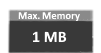
| Memory | 256 KB, 512 KB or 1 MB (70ns-100ns FPM DRAMs) |
|
| RAMDAC | External (50, 66 or 80 MHz) Samsung KDA0476 or Music TR9C1710 (both 8-bit 256 colour), Sierra SC11483/SC11487 (15-/16-bit HiColor), Trident TKD8001 (24-bit TrueColor) |
|
| See Also | Trident TVGA8800 Series Trident TVGA9000 Series |


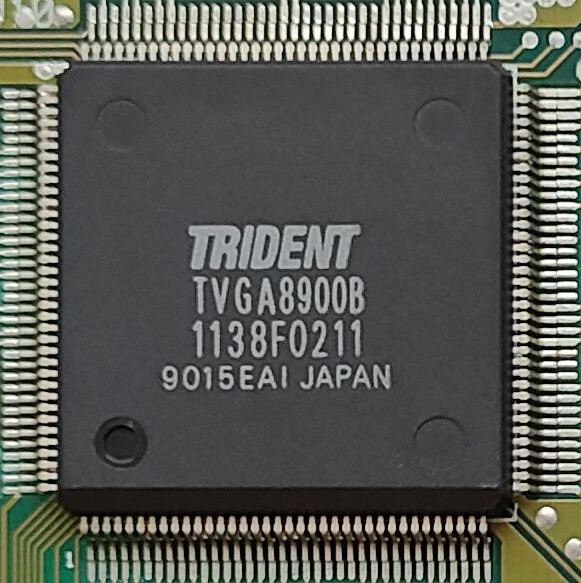
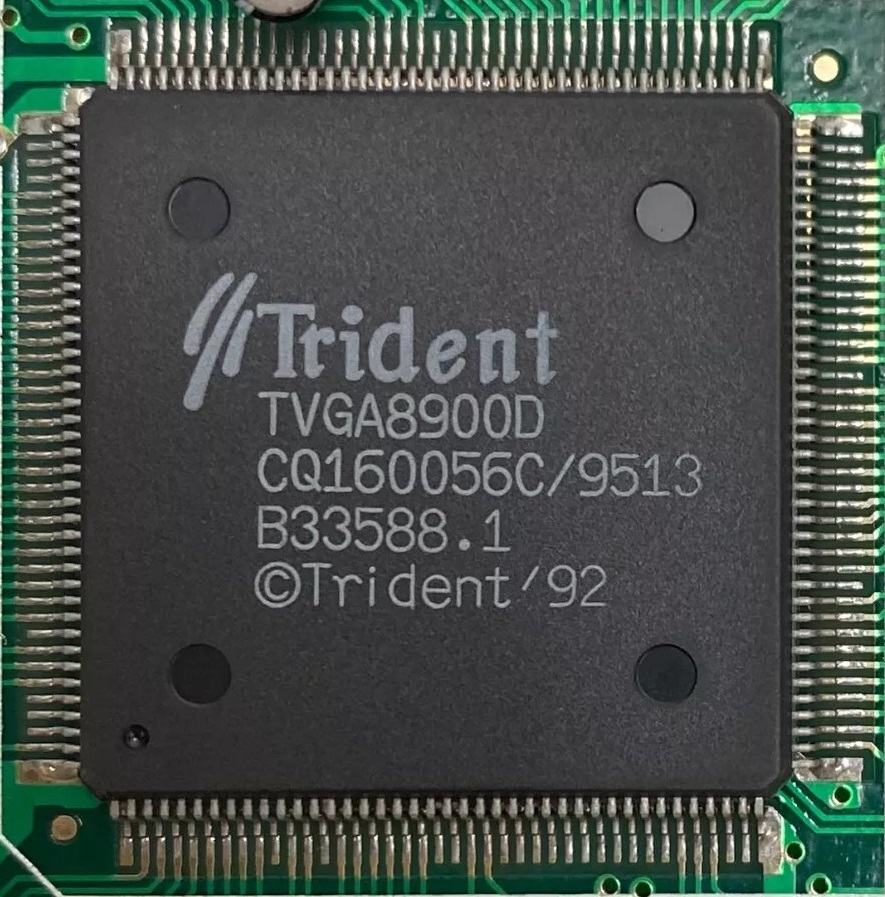
The Trident TVGA8900 series comprised the following variants:
- 8900B (1990) - 256 KB or 512 KB video memory. Core and memory clock speeds both 40 MHz. Max. 72 Hz refresh rate.
- 8900C and 8900CX (1991) - 512 KB or 1 MB video memory, choice of various RAMDACs.
- 8900CL and CX2 LC2 (1991) - Slightly faster and more stable variant of the 8900C and 8900CX.
- 8900D (1992) - TrueColor RAMDAC, faster performance with zero wait states, faster DRAM clock, 1 MB linear addressing, max. 75 Hz refresh rate.
One of the advantages of the Trident TVGA 8900 series was its high level of compatibility with older graphics card standards. Unlike many chipsets that emulated MDA, Hercules, CGA and EGA in the BIOS only, the TVGA 8900 series ensured register-level compatibility for all these older standards.
The first of the 8900 series of VGA chipsets, TVGA 8900B, could only access 256 KB or 512 KB of video RAM. Cards based on these were not particularly fast, and they supported screen resolutions up to 1024 x 768 in 16 colours or 800 x 600 in 256 colours. TVGA8900B-based cards often came with the minimum 256 KB of memory since they were intended to be budget-oriented cards, but often came with memory sockets for expansion up to the full 512 KB/1 MB. In September 1990, Trident added 8514/AI (Adapter Interface) emulation capability to their ROM BIOS (vC3.0 and later I think?), giving cards the ability to run software written to the 8514/A standard.
The TVGA 8900C and TVGA 8900CX followed in 1991, able to access up to 1 MB of video RAM. These cards typically have the common "MUSIC" chip, which is an 8-bit DAC. Cards typically support up to 70ns DRAMs. BIOS versions C3.0 and C4.3 are thought to be VESA 1.2 compliant. I'm not sure about C3.01, C4.0, C4.01 or C4.3. Apparently, Trident BIOS version C3.xx or later on a 8900C supports Sierra HiColor DACs (SC11483 or SC11487). The CX variant was likely a special fabrication with small updates in the silicon for certain customers.
Trident used the 8900C in their own card, the Impact III, which arrived in mid-1991 for a retail price of $195 for the 256 KB version, $229 for 512 KB, or $295 for 1 MB. This card came with a Quadtel BIOS [like almost all of the ISA-based Trident chipsets) and a conventional VGA 256-colour RAMDAC, though you could optionally buy a Sierra RAMDAC for an extra $50 or an Edsun RAMDAC for $100.
With 100ns memory the card was forced to run in interlaced mode at 1024 x 768, but with 80ns memory you could run at this resolution in non-interlaced mode. VESA compatibility relied on the loading of a TSR. The card also came with a utility to move the ROM BIOS into RAM (otherwise known as ROM shadowing).
The TVGA 8900CL chipset was a mildly enhanced version of the 8900C/CX. It was able to run slightly faster due to optimised internal logic. The "CL" stands for Cost-Reduced/Low Component. The 8900CL generally exhibited better stability, able to handle better timing on motherboards with erratic bus speeds. There were at least three sub-variants of the 8900CL, the TVGA8900CL-B, TVGA8900CL-C, and TVGA8900CL-D. Aside from this, they were functionally the same as the 8900C.
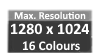
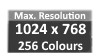
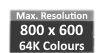
The TVGA 8900D arrived in 1992 with the key improvement being faster performance through zero-wait state direct memory writes on the ISA bus and a faster DRAM clock (48 MHz). It also added support for 1 MB of linear memory addressing (no more bank switching). It required just 3 support chips: TKD8001 TrueColor DAC/clock chip and two 256x4 DRAM chips. Maximum resolution was 1024 x 768 non-interlaced in 256 colours at 72 Hz refresh rate, or 1280 x 1024 interlaced in 16 colours. With the optional TKD8001 TrueColor DAC it was able to run up to 800 x 600 in 64,000 colours. The TKD8001 TrueColor DAC came in two flavours: a 15/16-bit variant which provided support for 800 x 600 in up to 64,000 colours, or a 24-bit variant which meant 16.7 million colours at 640 x 480 resolution. I've seen a sub-variant of the 8900D called the 8900D-R, which had a date code of late 1995 on a card with FCC ID: HNG890CL-BBD1TIA1.
Known BIOS versions for 8900D cards include C4.4 and C4.5. Most ROM BIOS' for the TVGA8900 series were 32 KB in size, held in two EPROM/EEPROM chips with high bytes in one and low bytes in the other. Later cards merged these into a single IC.
Benchmarking
Back in 2021, I ran a set of benchmarks that compared the 8900CL with the 8900C, Paradise PVGA1A, ET4000, and Cirrus Logic CL-GD510/520.
Around 2024, I ran another set of benchmarks that included an 8900CL with 'fast' 70ns DRAMs against the ATI Graphics Ultra, Diamond Stealth VRAM, and Tseng Labs ET4000.
Both these tests confirmed that using faster DRAM memory is key to getting the best performance out of otherwise slower ISA graphics cards, but chipset efficiency certainly plays a part. Another point to note from my experience with Trident 8900 cards is that they don't play nicely when run on an overclocked bus. Where my ET4000 cards will happily run on a 12 MHz or higher bus, the Tridents I have fail to POST even at 10 MHz.
Video Modes
In addition to the modes found on standard VGA cards (00h-07h, 0Dh-13h), the TVGA 8900 series supported the following extended text and graphics modes:
| Mode # | Text/Graphics | Resolution | Colours | Text Block/Type | Notes |
|---|---|---|---|---|---|
| 50h | Text | 80 x 30 | 16 | (8x16) | |
| 51h | Text | 80 x 43 | 16 | (8x11) | |
| 52h | Text | 80 x 60 | 16 | (8x8) | |
| 53h | Text | 132 x 25 | 16 | (8x14) | |
| 54h | Text | 132 x 30 | 16 | (8x16) | |
| 55h | Text | 132 x 43 | 16 | (8x11) | |
| 56h | Text | 132 x 60 | 16 | (8x8) | |
| 57h | Text | 132 x 25 | 16 | (9x14) | |
| 58h | Text | 132 x 30 | 16 | (9x16) | |
| 59h | Text | 132 x 43 | 16 | (9x11) | |
| 5Ah | Text | 132 x 60 | 16 | (9x8) | |
| 5Bh | Graphics | 800 x 600 | 16 | Planar | |
| 5Ch | Graphics | 640 x 400 | 256 | Packed | |
| 5Dh | Graphics | 640 x 480 | 256 | Packed | |
| 5Eh | Graphics | 800 x 600 | 256 | Packed | |
| 5Fh | Graphics | 1024 x 768 | 16 | Planar | |
| 60h | Graphics | 1024 x 768 | 4 | Planar | Interlaced |
| 61h | Graphics | 768 x 1024 | 16 | Planar | Portrait monitor required |
| 62h | Graphics | 1024 x 768 | 256 | Packed | 1 MB cards only, NI |
| 6Ch | Graphics | ? | ? | ? | 1 MB cards only, NI |
| 74h | Graphics | ? | ? | ? | 1 MB cards only, NI |
| 75h | Graphics | ? | ? | ? | 1 MB cards only, NI |
| 76h | Graphics | ? | ? | ? | 1 MB cards only, NI |
| 77h | Graphics | ? | ? | ? | 1 MB cards only, NI |
The TVGA8900B can be found on the following graphics cards:
- Trident Microsystems TVGA 8916
- Octek (unknown model)
TVGA8900C chipsets can also be found on the following cards:
- Octek MVGA 2000-II
- Trident Microsystems Impact III
- Unknown card with FCC ID: HNG 8916CX248 LC2
- Unknown card with FCC ID: KBI 8900CL4X256
TVGA8900D chipsets can be found on these cards:
- Trident Microsystems card with FCC ID: HNG890CL
- Hightech Information System Ltd (HIS) card with FCC ID: KBI8900CL4X256
Competition
In 1990 when the Trident TVGA8900 chipset first launched, the VGA graphics market was hugely competitive. Windows 3.0 was gaining traction, and impacted greatly on the consumer graphics card market. Home PC users now demanded higher resolutions and colour depths to see and use Windows in all its glory. Screen resolutions of 1024 x 768 were now the minimum standard when not playing games (which typically still ran in 320 x 200 in full-screen DOS). This was just about the limit for the average monitor at the time, which would have been a 14" SVGA on standard and premium PCs.
The same graphics card brands were there as had been over the past few years: ATI, Everex, Western Digital/Paradise, Video Seven, Genoa, Tseng Labs, and Cirrus Logic.
In the Media
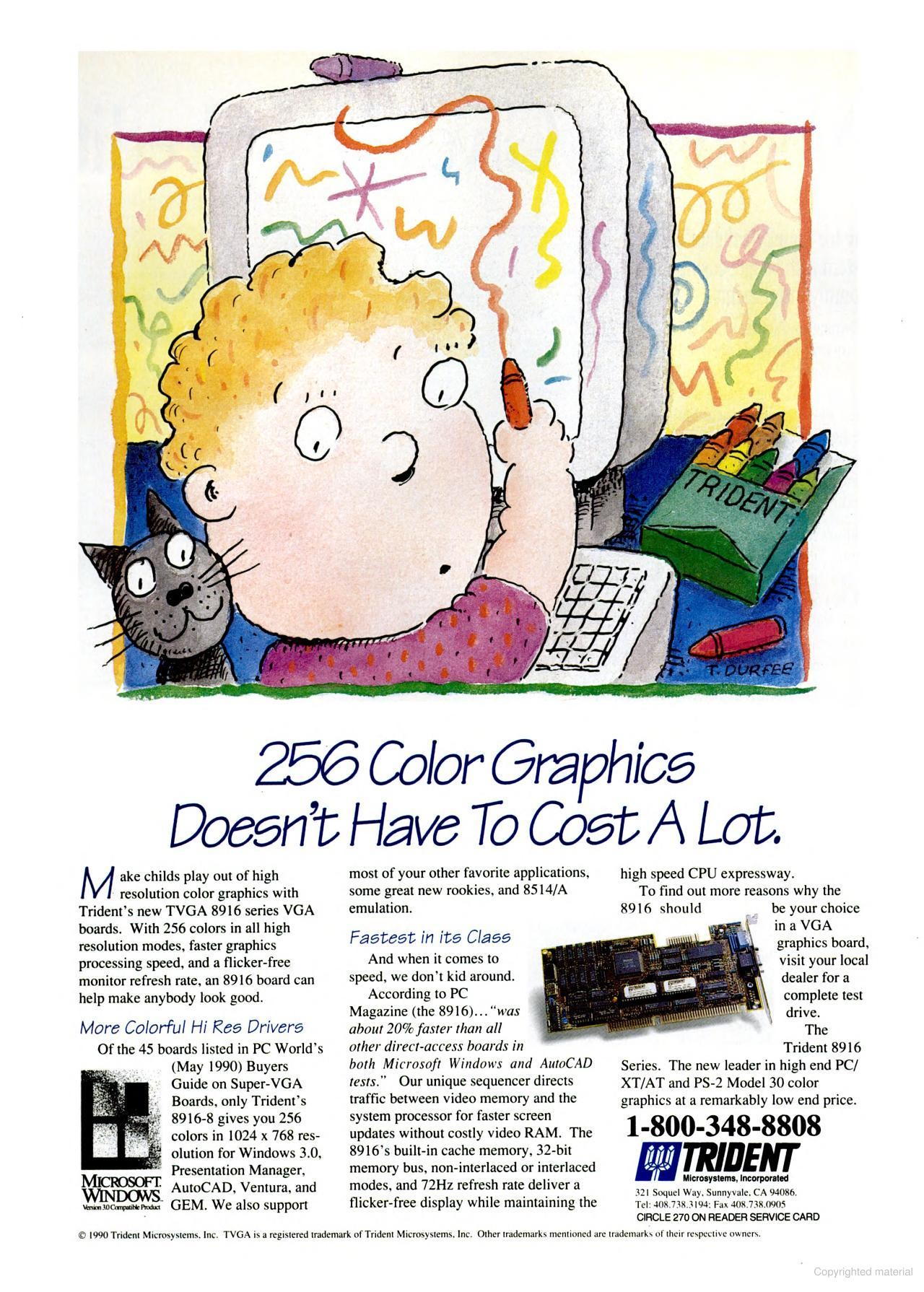
Advert for Trident's 8916 series graphics cards, October 1990
The TVGA 8900 Super VGA board can display up to 256 colors in interlaced or non-interlaced resolutions as high as 1,024 by 768 pixels, and supports VGA, EGA, Hercules, CGA, and MDA graphics display modes.
A 32-bit data memory bus and internal cache design on the board make it possible for the TVGA 8900 to use slower memory rather than VRAM for standard applications, according to the company. The board can support standard VGA modes such as 640 by 480 in 256 colors, or 800 by 600 in 16 colors with only two 256 KB chips. Eight 256 KB chips can support 1,024-by-768 resolution in 256 colors for non-interlaced monitors.
Drivers supporting the TVGA 8900's extended modes include those for current releases of Lotus 1-2-3, Autocad, Pagemaker, Ventura, Windows, and Presentation Manager.
Suggested retail prices for the TVGA 8900 board are $199 for the 8-bit board with 256K of RAM; $245 for the 16-bit version with 256K of RAM, $315 for the 16-bit board with 512K of RAM; and $569 for the 16-bit board with 1 megabyte of RAM. "
InfoWorld, March 1990
To test these cards in the highest resolutions they were run using AutoCAD, OS/2 1.2, and Windows 3.0.
"Resolution: Supports 1,024 by 768 in 256 colors.
Speed: Although most benchmarks rival the other cards in the comparison, the AutoCAD redraw times were extremely slow.
Driver Support: Supports AutoCAD and a variety of other applications.
Setup: Installation is easy to follow.
Serviceability: External DIP switches makes for simple modification.
Support Policies: Trident has a two-year warranty.
Final Score: 6.0"
This final score put the TVGA in the middle of the Super VGA trio, with the Headland V-RAM VGA coming in at 7.1 due to Headland's 7-year warranty, good surface-mount components, excellent technical support, and most importantly, the best VGA performer. The Western Digital Paradise VGA 1024 came last in the Super VGA group with a score of 5.8. It could only handle 1024 x 768 in 16 colours, only had a 3-year warranty, setup instructions and other documentation were only satisfactory.
InfoWorld, July 1990
CONS: Slow performance
The Trident Impact III costs only $12 more on the street than the rock-bottom Boca SuperVGA. Amazingly, for that low $172 price, you get the widest selection of drivers in the roundup.
Trident provides 132-column drivers for Word and WordStar, plus 256-color drivers in all super-VGA resolutions for both Windows and AutoCAD. You don't get a menu for swapping drivers, though, and hardware installation isn't switchless.
The board's speed could be better. In most of the key performance benchmarks, the Impact III hovered in the bottom third.
If you like the idea of 132-column word processing in Word, this board is your best choice. Otherwise, bargain hunters would do better to opt for the superior performance, switchless installation, and even lower price of the Boca SuperVGA."
PC World, August 1991
Setting it Up
The included software driver and utility disks that were provided with TVGA8900-based graphics cards usually came with these DOS utilities from Trident (sometimes found in a directory called TVGAUTIL):
- SVM89.EXE - Switch Video Mode
- TVGABIO.SYS - can improve display speed by copying the VGA ROM BIOS into an area of system memory
- TANSI.SYS - replaces standard DOS ANSI.SYS and supports extended text display modes
- VESA.EXE - installs VESA BIOS extensions into memory
- BIC.EXE - reports your PC's system BIOS information
- MODETEST.EXE - checks your monitor's ability to run any display mode
- MAMODE.EXE - selects 64 KB or 128 KB memory addressing scheme for high-res programs
- PMFIX.EXE - for OS/2, circumvents display problem when using a standard VGA driver and switching between full-screen OS/2 and Presentation Manager.
- RIXFIX.EXE - allows RIX programs to operate correctly
- SMONITOR.EXE - use on monitors that don't conform to the monitor pinout standard and thus boot up in VGA monochrome
- TVGACRTC.EXE - allows users to adjust video display specifically for their monitor. May also be used to select 70 Hz refresh rate for 1024x768 NI modes.
Trident cards that used the TVGA8900 series chipsets usually had a 6-switch DIP switch block accessible from the backplate. I don't have information on what these are specifically used for - they may be the same as for the TVGA8800 series.
In addition, some TVGA8900 cards have jumpers:
| Jumper | Meaning | Configuration |
|---|---|---|
| J1 | IRQ9 interrupt control | 1-2 = Enabled 2-3 = Disabled |
| SW3 | Select scan rate - allows you to configure scan rates of extended VGA modes to be compatible with a multiscan monitor. Works only with 512 KB / 1 MB configurations. | Open = 48.7 kHz scan rate (allows 1024 x 768 and higher to run in non-interlaced) Closed = Default scan rate |
| SW4 | BIOS autodetect | Closed = disable autodetect Open = enable autodetect (BIOS will detect whether card is in 8-bit or 16-bit slot and configure accordingly) |
| J6 | Monitor detection control. (use if your PC boots into monochrome VGA) | 1-2* = Normal 2-3 = non-standard monochrome Unjumpered = non-standard colour |
Downloads
TVGA 8900D Datasheet Trident TVGA8900D Graphics Controller datasheet |
TKD8001 Datasheet Trident TKD8001 RAMDAC datasheet |
TVGA8900C User Manual 32 MB ZIP file containing each page of one of an 8900C card's user manual |
TVGA8900D/9000i User Manual A User Manual for SVGA graphics card that used either the 8900D or 9000i chipset. |
TVGA 8900 Drivers and Utilities
Contains the TVGAUTILs and Windows 3.1 display drivers (includes HiColor and TrueColor modes) |
TVGA 8900C Driver Disks
Driver disks for DOS applications. The second disk has Windows 3.0 and OS/2 display drivers |
TVGA 8900D Windows 3.1 Driver
Windows 3.1 display drivers (includes HiColor and TrueColor modes) |
TVGA 9000 Series Drivers / Utilities
Includes Windows 3.1 high-res display drivers. Also works for TVGA8900 series and later 9440, possibly more. |
TVGA 8900D Windows 3.1 Driver
Windows 3.1 display drivers (includes HiColor and TrueColor modes) |
Windows 95 Beta Driver
Non-Accelerated Windows 95 driver for 9420DGI VL/PCI, 9440VXi VL, and 9440 AGi VL. Also works on 8900C, 8900CL, 8900D, and 9000i. |
TVGA8900B ROM BIOS A 32 KB ROM BIOS dump |
TVGA 8900C BIOS A 32 KB ROM BIOS dump |
TVGA 8900C BIOS
Get in touch if you can provide this missing file! |
TVGA 8900C BIOS
Get in touch if you can provide this missing file! |
TVGA 8900C BIOS
Get in touch if you can provide this missing file! |
TVGA8900CL-B ROM BIOS A 32 KB ROM BIOS dump |
TVGA8900CL-C ROM BIOS A 32 KB ROM BIOS dump |
TVGA8900D ROM BIOS A 32 KB ROM BIOS dump |
TVGA 8900D BIOS
Get in touch if you can provide this missing file! |
TVGA 8900D BIOS
Get in touch if you can provide this missing file! |
|





More Pictures
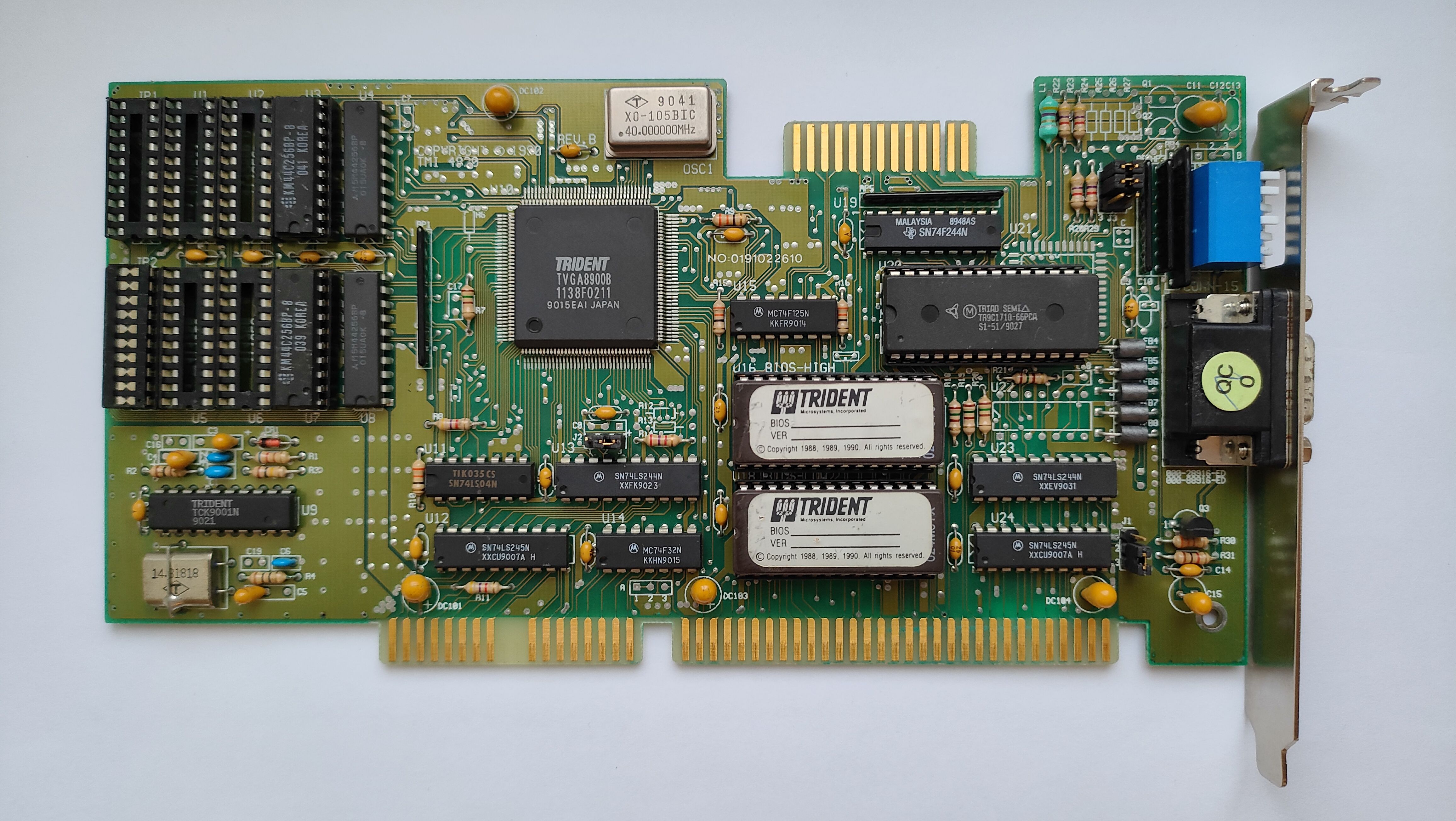
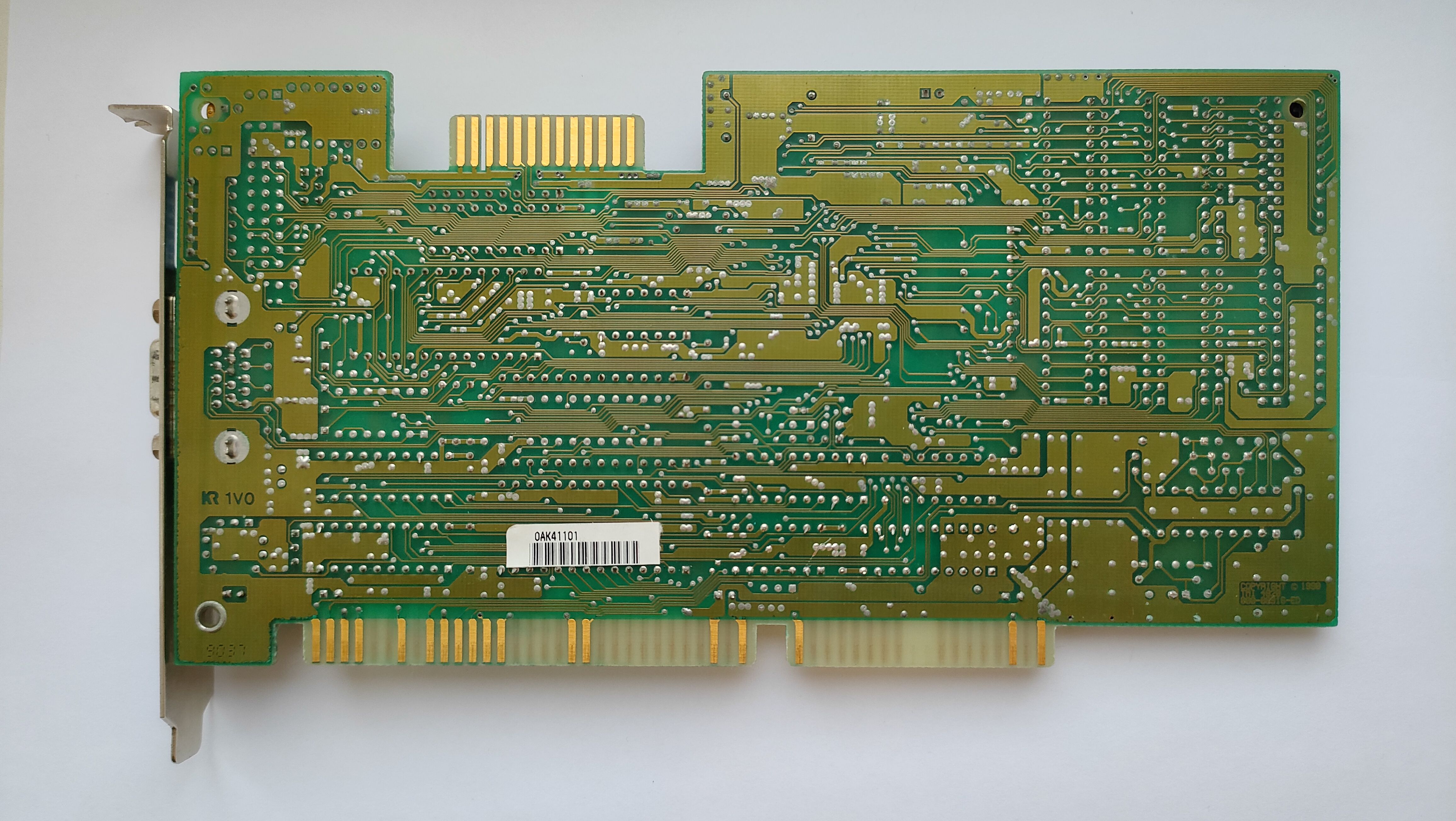
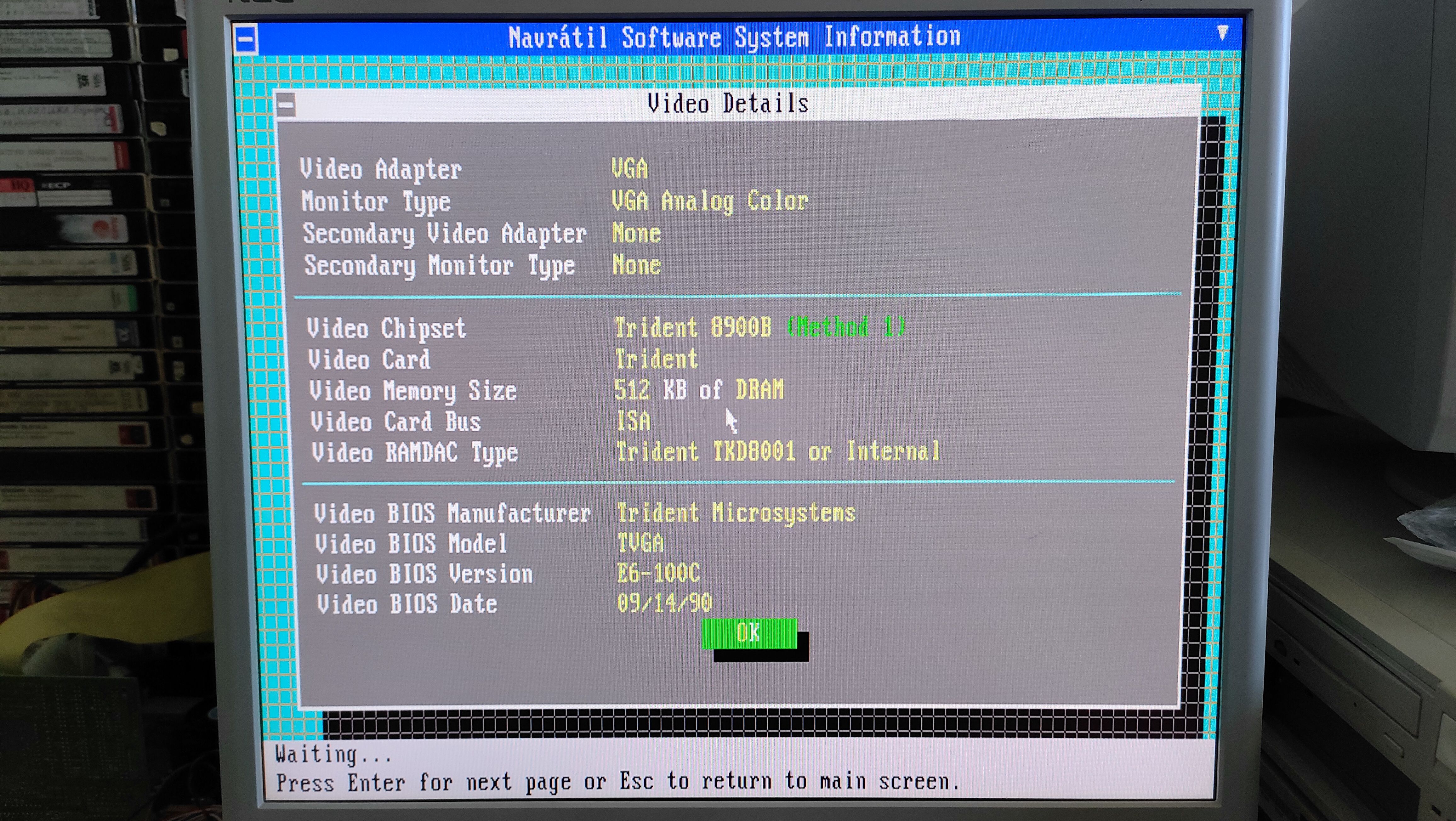
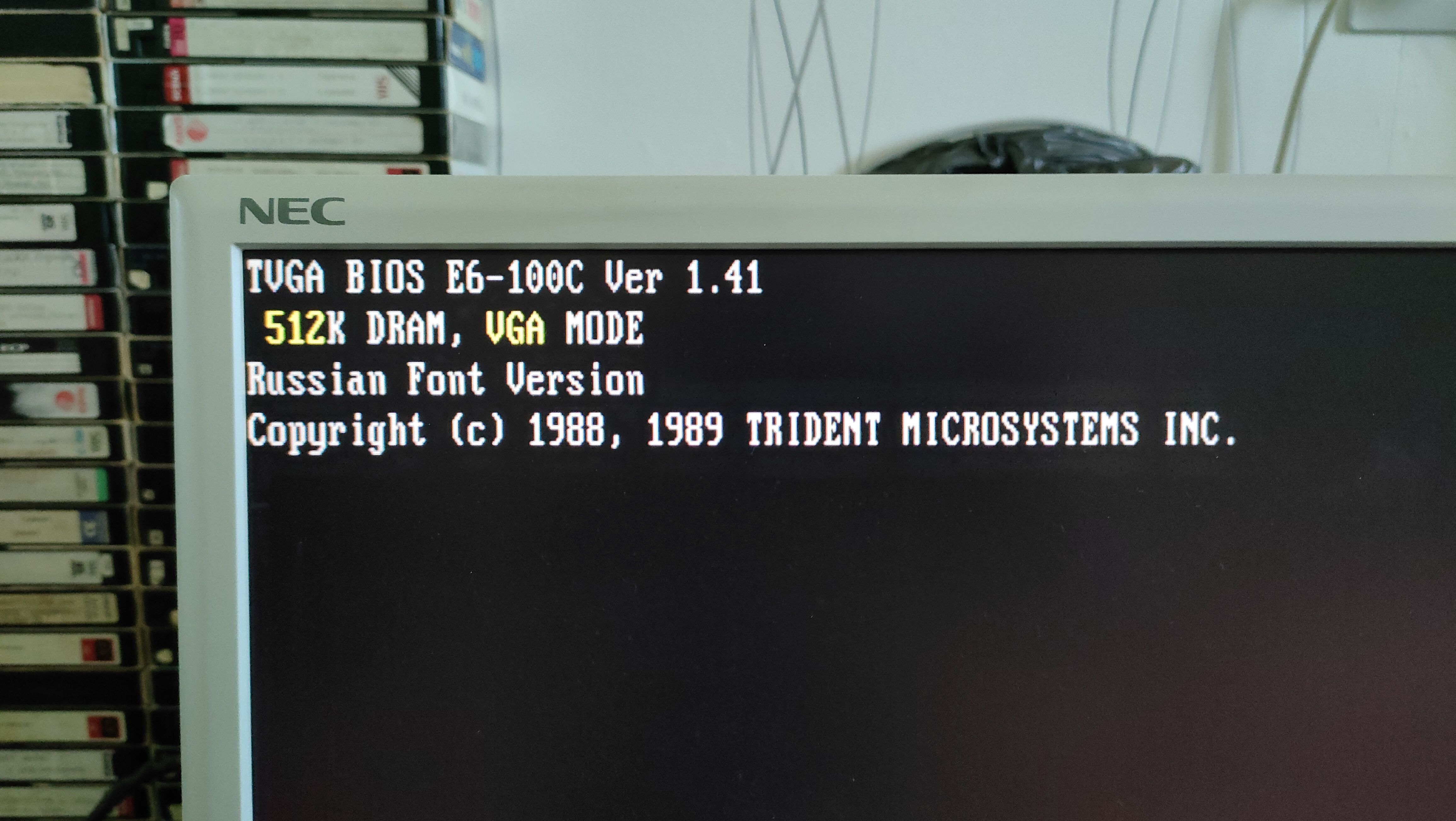
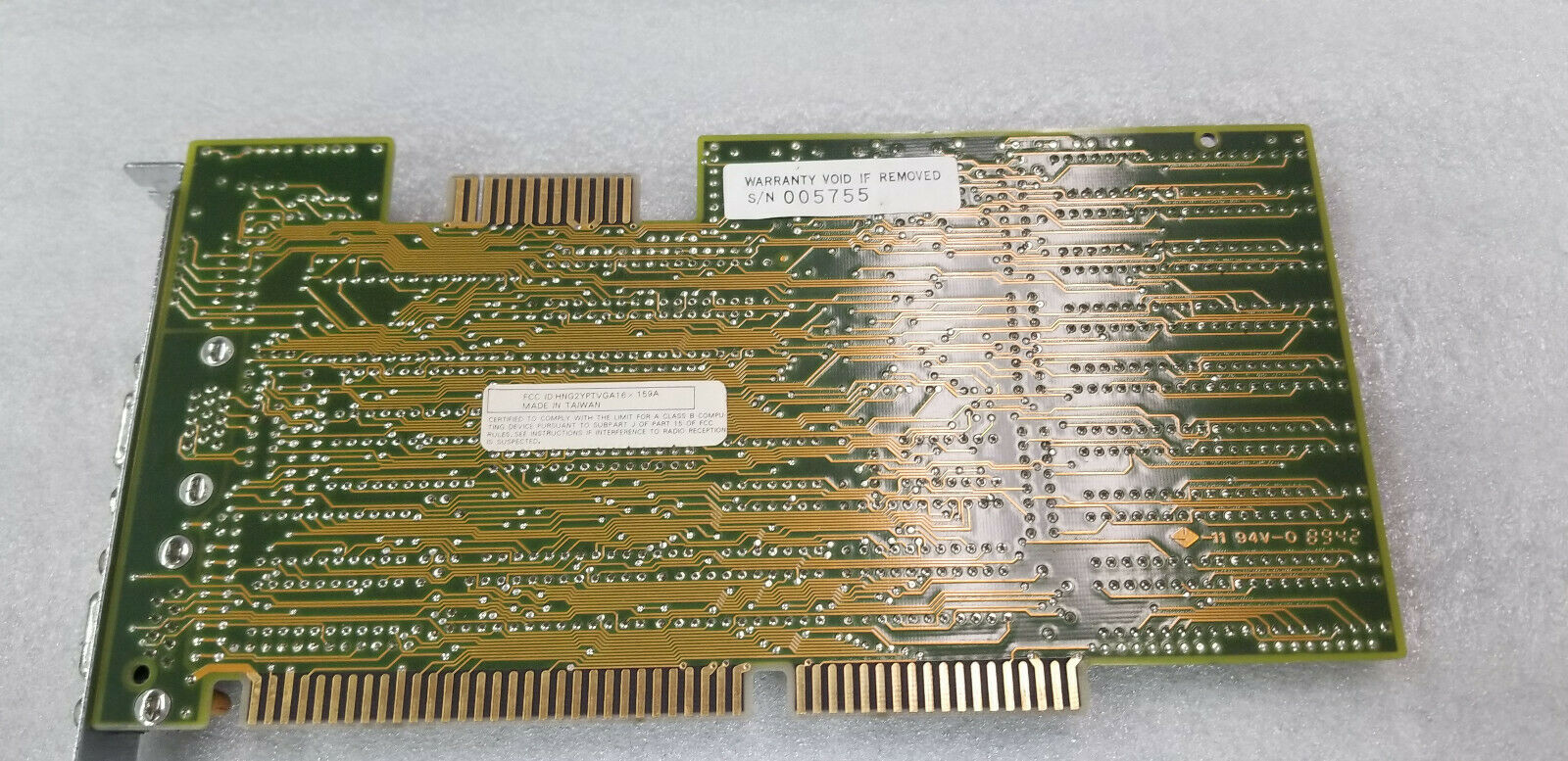
A 512 KB Trident TVGA 8900B
card, courtesy of DOS Days' contributor, crizalis
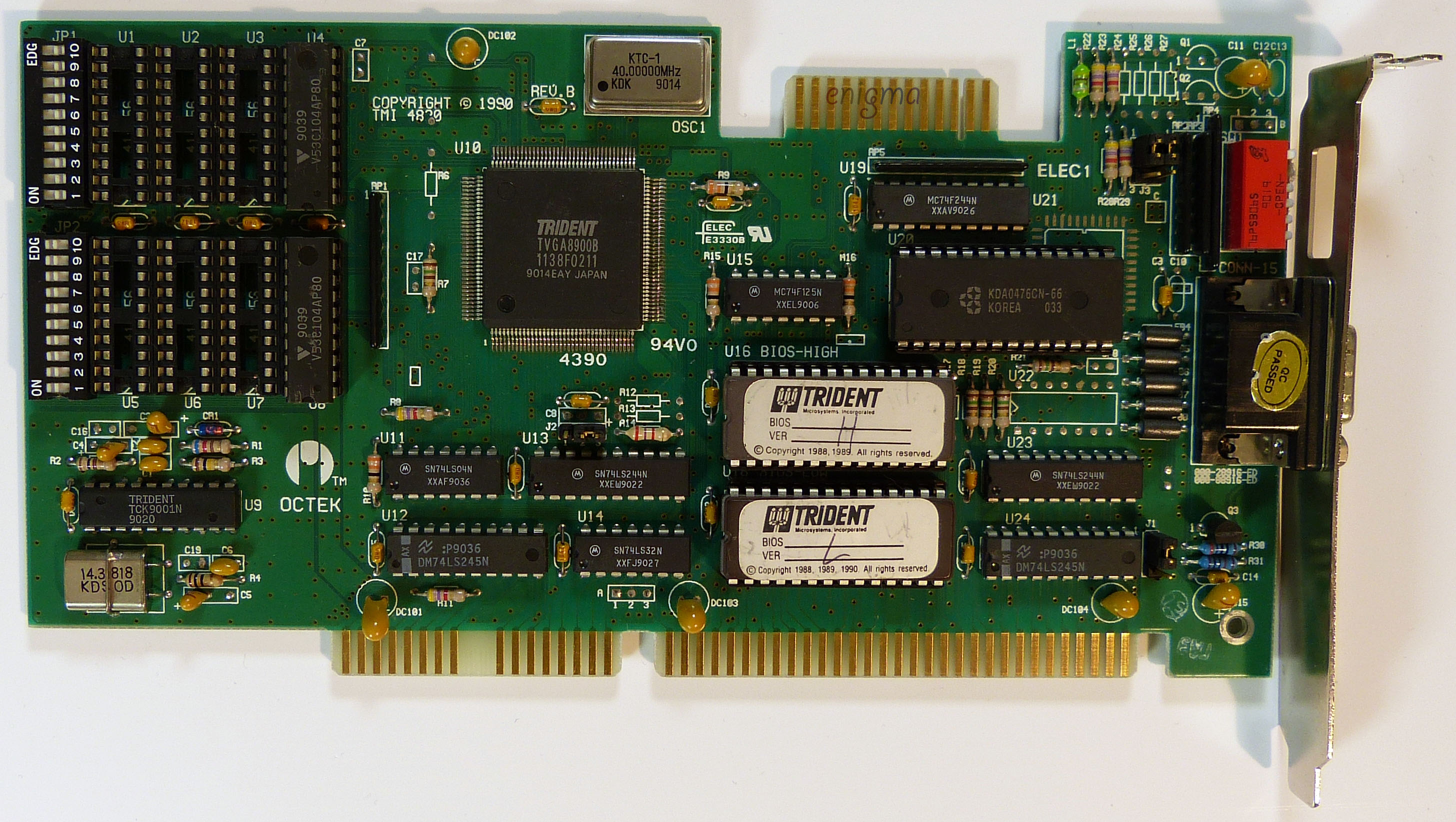
An Octek
MVGA card with its TVGA8900B and 256 KB of memory, ca. 1990


Another Trident TVGA 8900B card
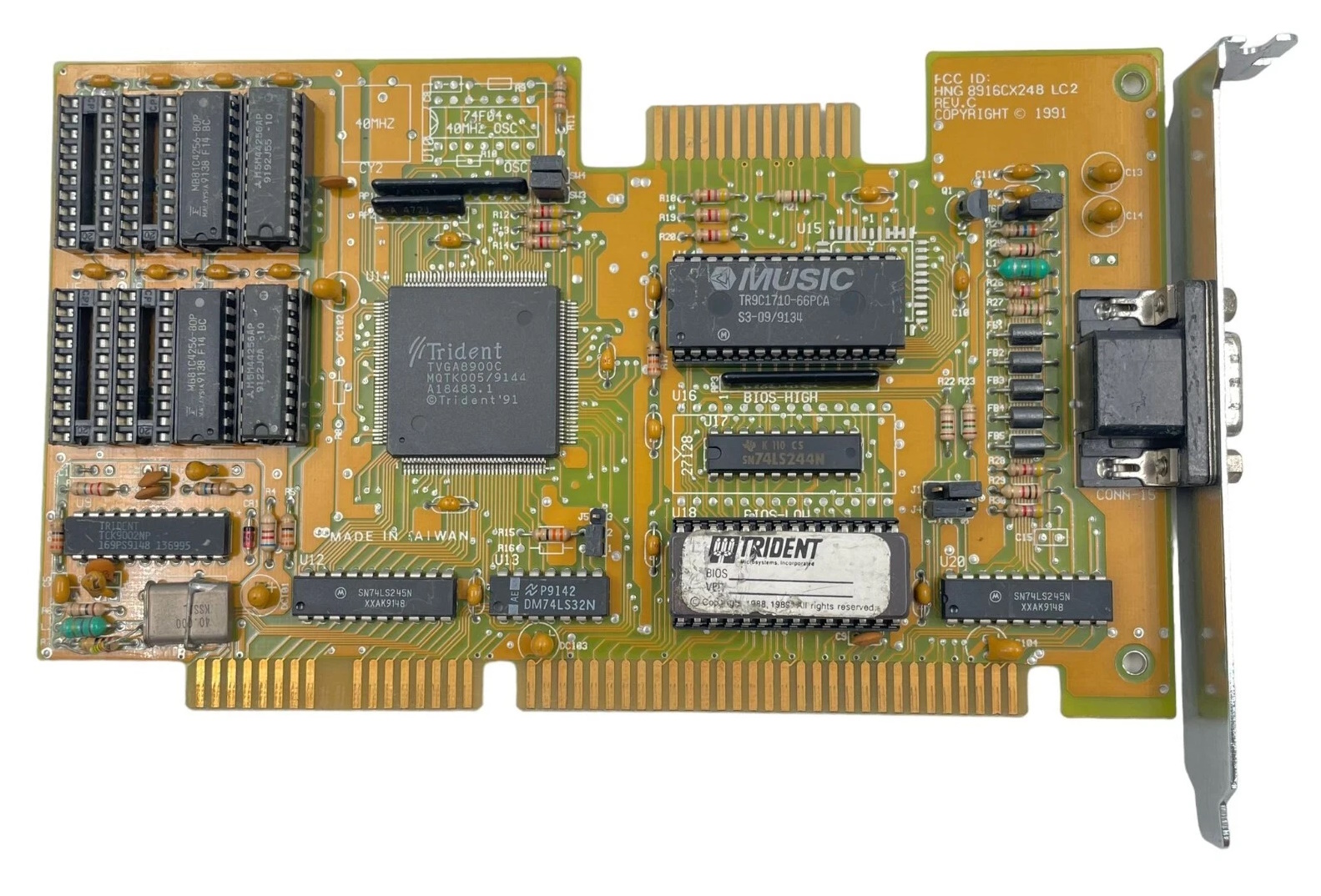
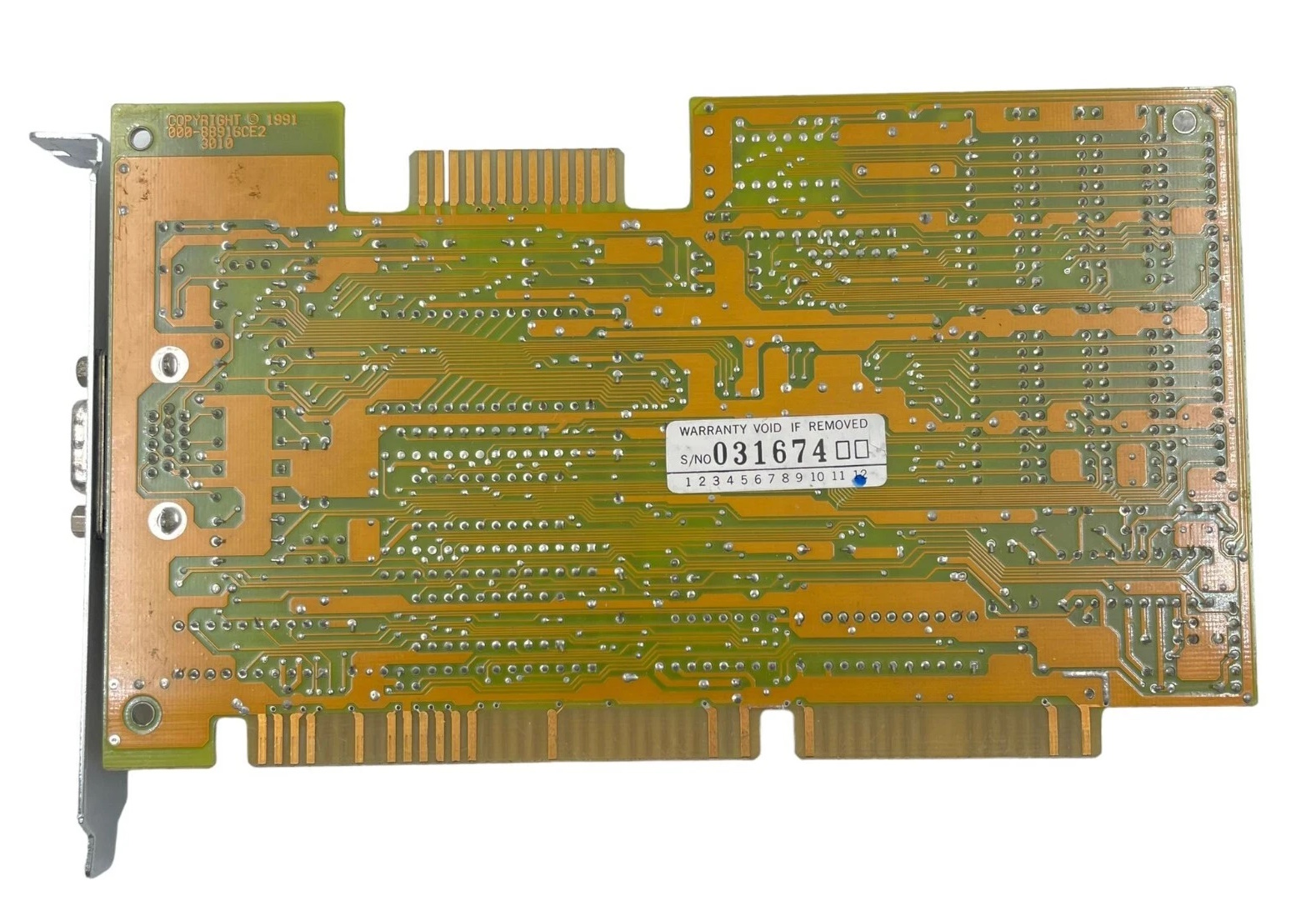
A Trident TVGA8900C card with 512 KB of RAM (FCC ID: HNG8916CX248 LC2)
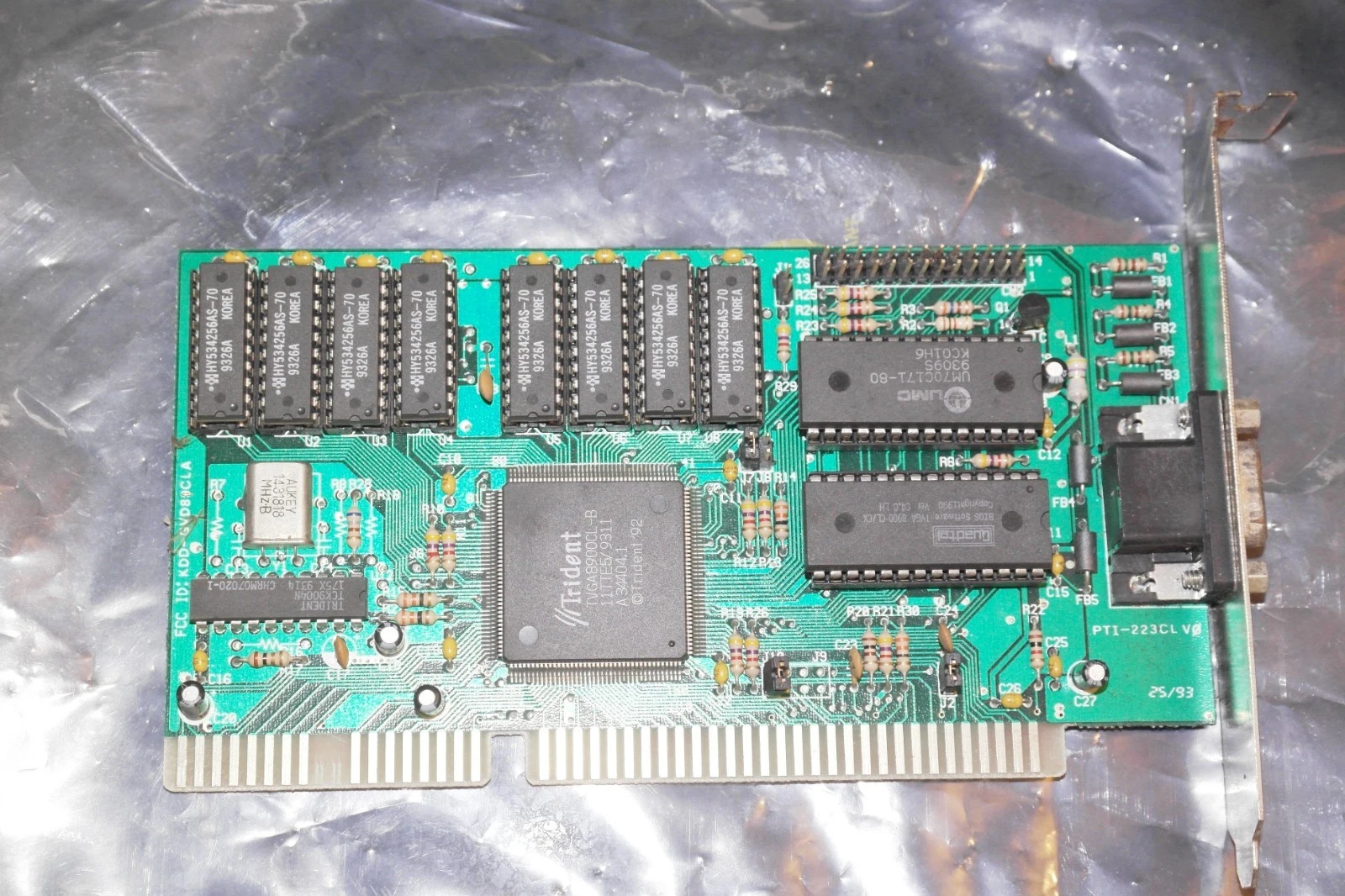
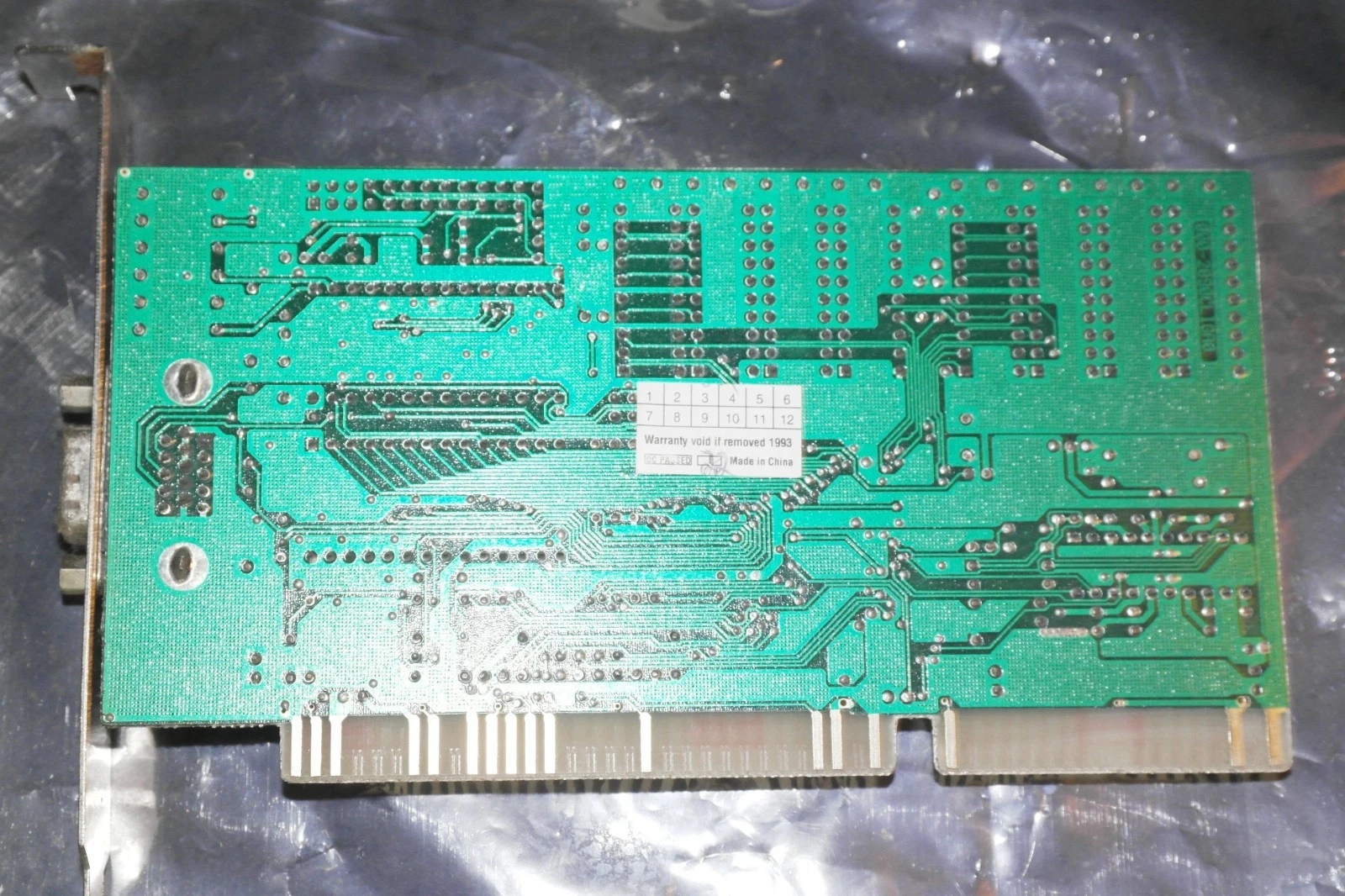
A Gemlight Computer Ltd TVGA8900CL-B card with 1 MB of RAM (FCC ID: KDD-GVD89CLA)
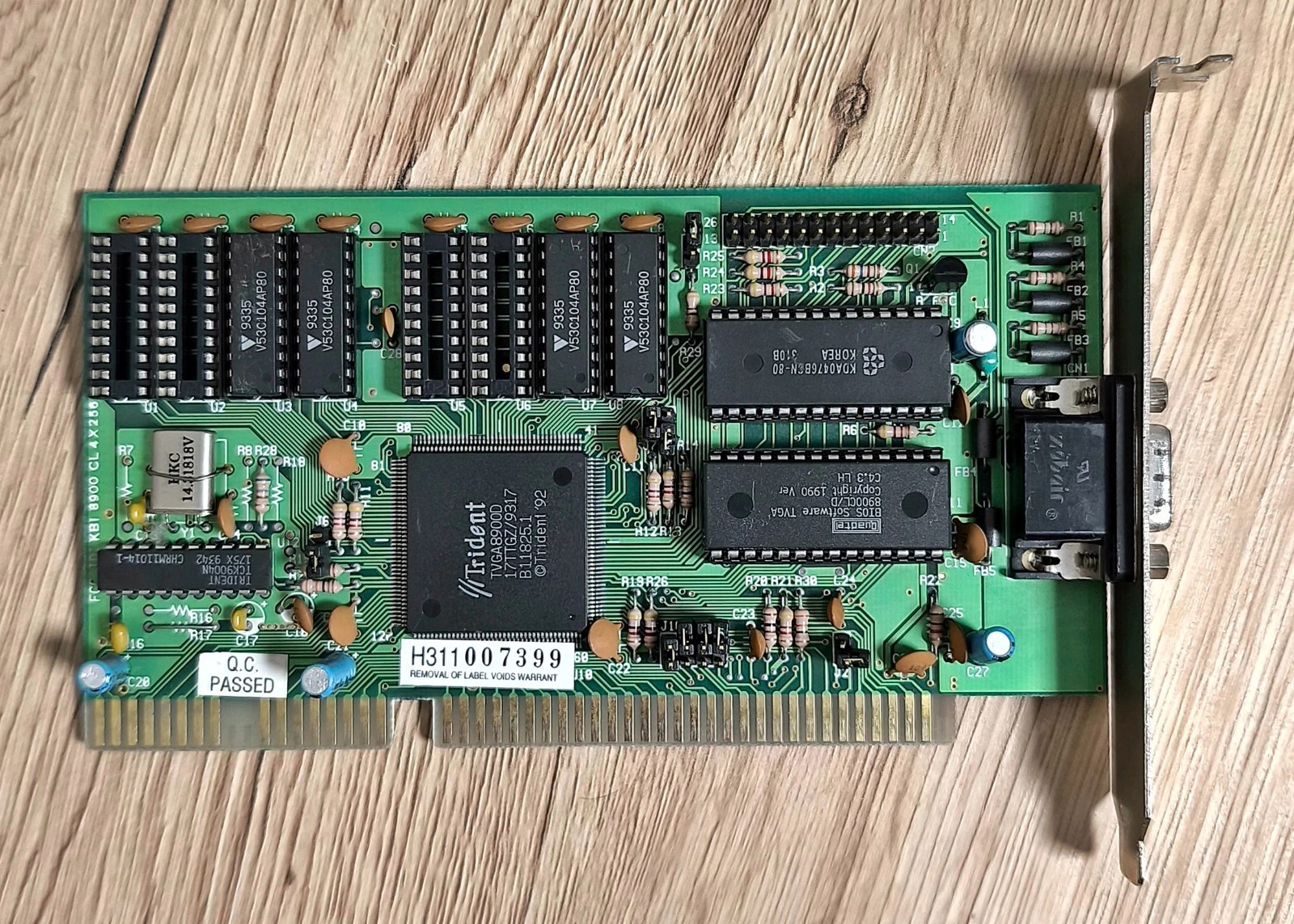
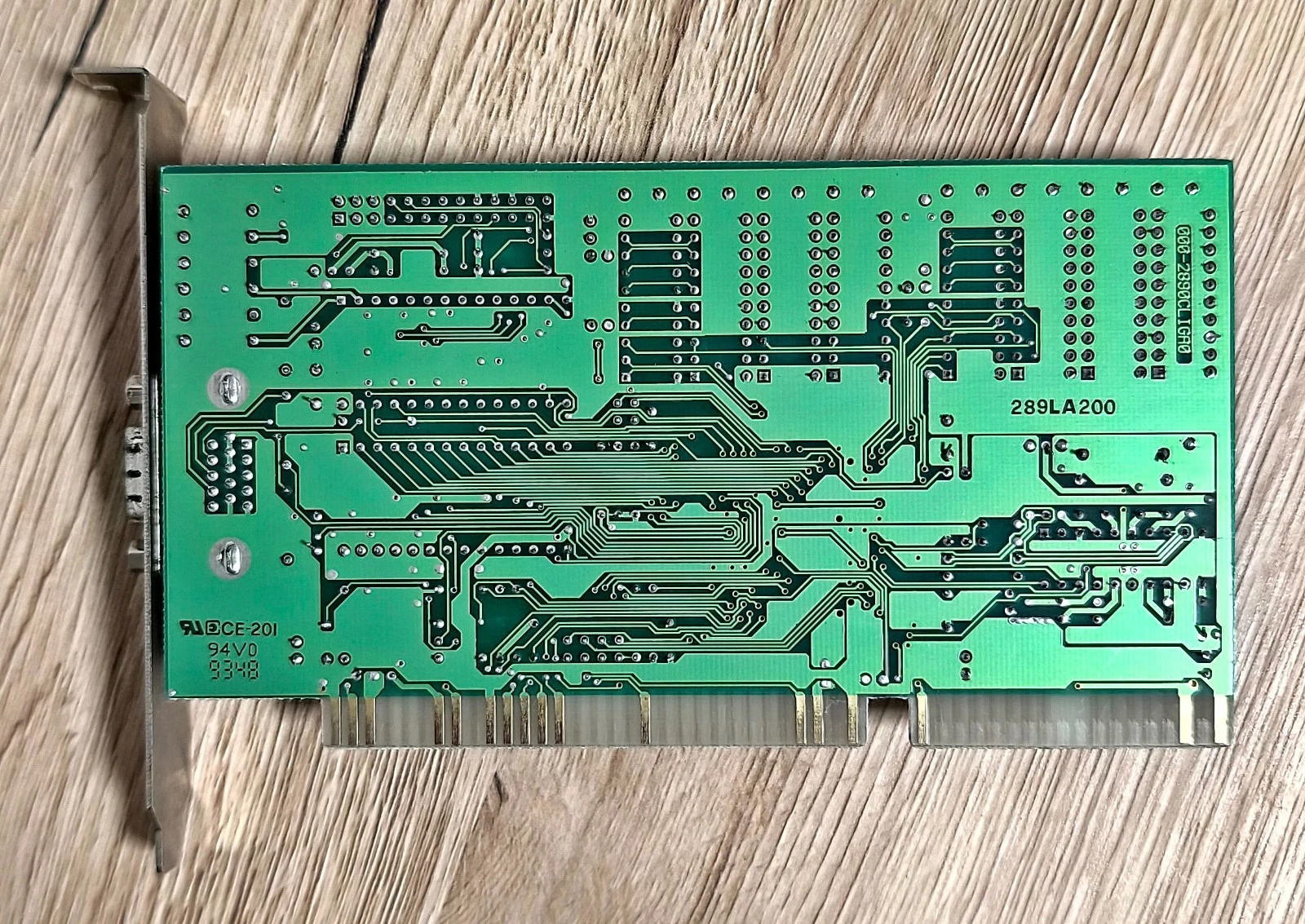
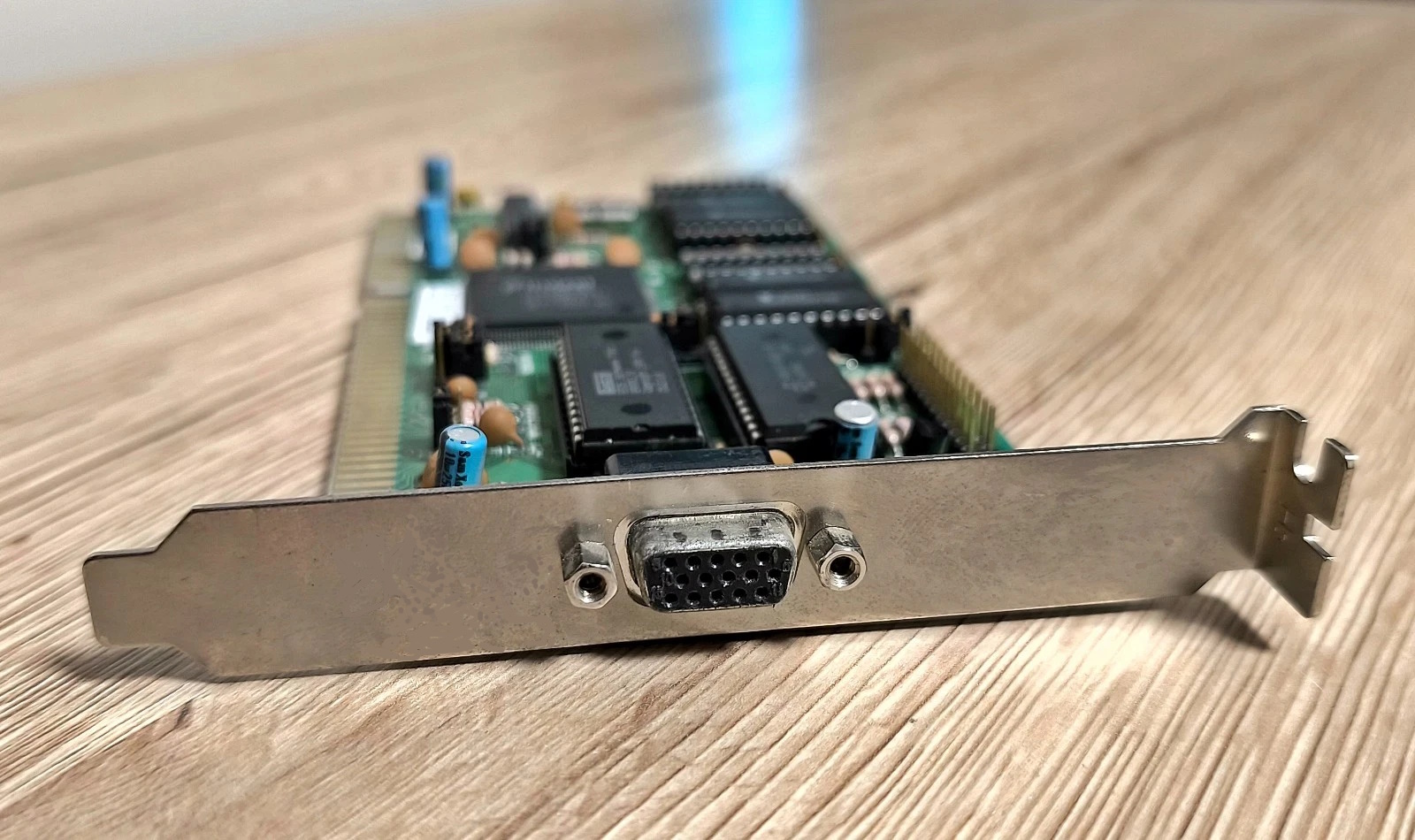
A Trident TVGA8900D card with 512 KB from Hightech Information System Ltd, (FCC ID:
KBI8900CL4X256)
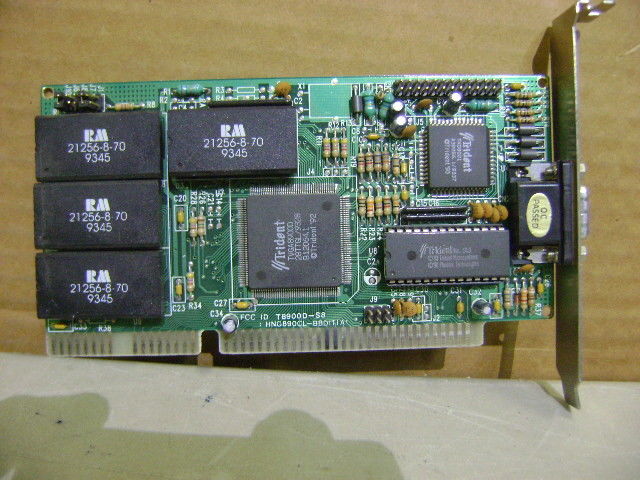
A Trident TVGA8900D card with 1 MB of memory (FCC ID: HNG890CL)
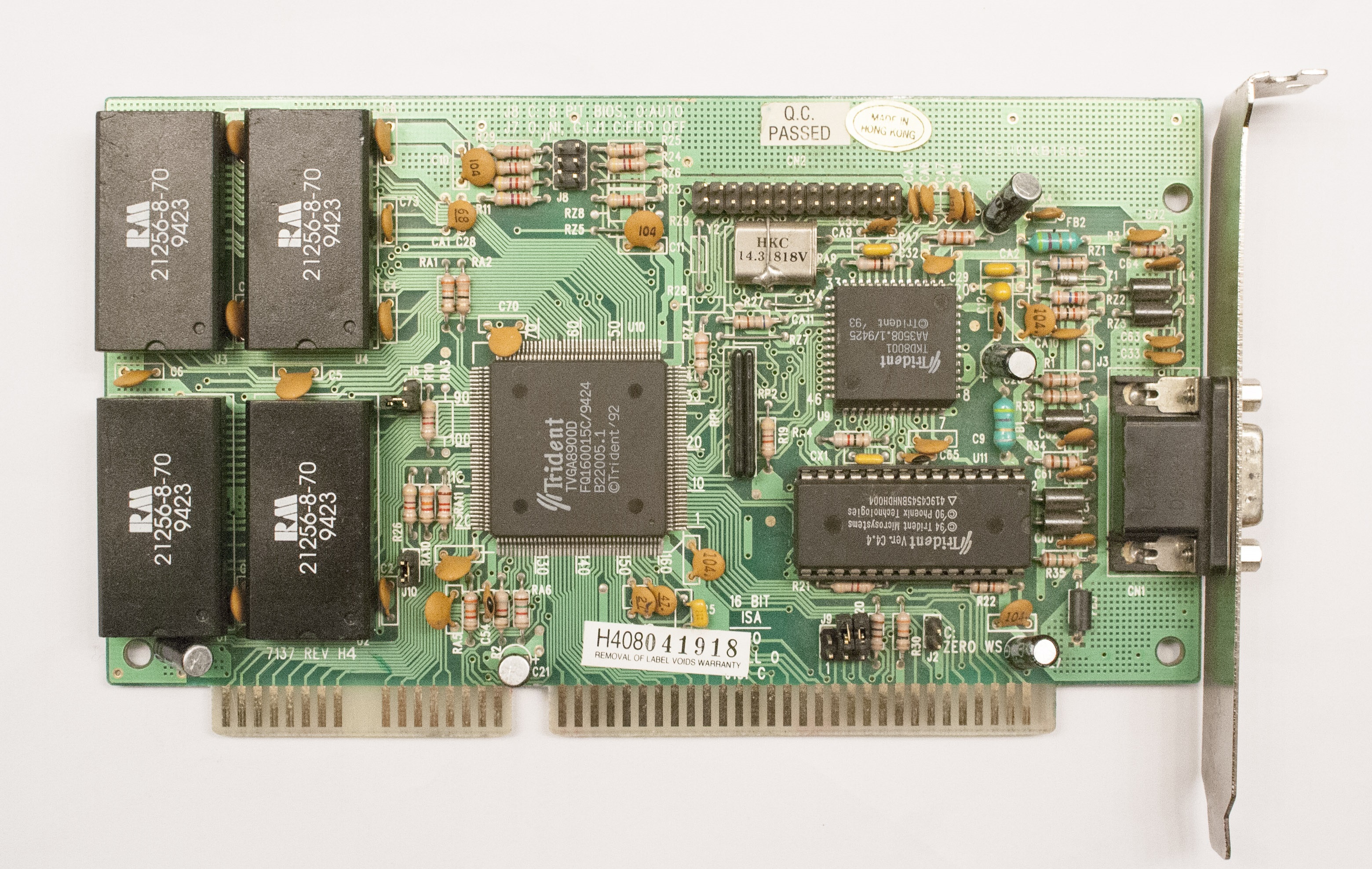
A Trident TVGA8900D card with 1 MB of memory - image courtesy of DOS Days' contributor Steve Wolf