 IBM OS/2
IBM's OS/2 (Operation System/2) was first announced in April 1987 and arrived in December 1987 with a price tag of $325. Called OS/2 Standard Edition 1.0, it was an 80286-based multi-tasking operating system that implemented virtual memory on a segment basis. This overcame one of the biggest challenges that DOS faced - the ability to access all the installed memory.
OS/2 ran in one of two modes. In DOS mode, it ran just like pure DOS - only one application could be run at any one time. In OS/2 mode, multiple applications could be running simultaneously in each of the 12 available 'sessions'.
System requirements for OS/2 Standard Edition 1.0 were an 80286 processor (all 1.x versions ran in 16-bit protected mode), 2 MB of RAM or 1.5 MB if you forego the need to have DOS mode. It comes on four 1.44 MB floppy disks, and after installation takes up about 3.4 MB of your hard disk.
With the simultaneous announcement of OS/2 by IBM and Microsoft on April 2, we have entered a new era of microcomputer operating systems. The introduction of OS/2 may prove as significant to the future use of information systems as was the introduction of IBM's original OS in 1964.
I am struck with a remarkable sense of deja vu and am reminded of my first attempts to wade through the intricacies of OS internals in IBM manuals and classes for system programmers back in the late '60s.
This time, of course, there are some substantial differences. OS was strictly an IBM-developed product. OS/2, on the other hand, is primarily a Microsoft product, even though IBM has had a significant influence on its development and specifications.
Unlike IBM's original OS, OS/2 will be available to run on systems from other vendors at about the same time it is available for IBM systems. OS/2, unlike OS but like MS- and PC-DOS and Unix/Xenix, will be an industry-standard operating system that is not tied to any vendor's hardware.
Nevertheless, there are strong points of similarity between OS and OS/2. Both, for example, have initially been offered in several different versions.
IBM's OS/2 Standard Edition includes the kernel, the command prompt system comes in Version 1.0, and Microsoft Windows capabilities are added in the form of the Presentation Manager in Version 1.1. IBM will also offer OS/2 Extended Edition 1.0 with IBM-developed communications and database applications.
IBM's original OS also came in several varieties. The basic version was OS/PCP, which stood for Operating System/Primary Control Program. The two other primary versions were OS/MFT and OS/MVT. The name extensions stood for "multiprogramming with a fixed number of tasks" and "multiprogramming with a variable number of tasks," respectively.
Initially run primarily as batch-oriented systems, OS/MFT required a set number of memory partitions of specific size to be defined. As many programs could be run simultaneously as there were partitions to run them in, but they could only fit into partitions large enough to hold them.
With OS/MVT, memory was dynamically allocated to tasks; the number of tasks could be varied. The additional complexity of OS/MVT naturally required a significantly larger amount of memory for the basic operating system than did OS/MFT. It was only on the very largest mainframes that OS/MVT could run. These big mainframe systems of the late '60s sometimes had as much as 1 megabyte of main memory! A big application was one that might use all of 265K.
In terms of processing power and storage, ordinary PCs today easily exceed those of even the largest mainframe systems of the late '60s. And in terms of its capabilities, sophistication, and complexity, OS/2 easily exceeds those of OS/MVT.
One of the most interesting aspects of OS/2 is how comfortably familiar it will seem to those who grew up with mainframe systems in the '60s and '70s. While many aspects of OS/2 will seem strange and unfamiliar and will require significant learning for those whose background is strictly in personal computers, for us old DP [data processing? ed.] types OS/2 is like being back in the neighborhood where we grew up.
A great deal has changed, too. OS/2 is at least as different from OS as it is similar. The reasons have a lot to do with the way the world has changed over the past 20 years.
The key difference is that OS/2, while designed to handle multiple tasks simultaneously, is not designed to handle multiple users simultaneously. Even though OS/MFT and OS/MVT were primarily characterized by the way they handled multitasking, they were inherently also multiuser. Unix, intended from the start for on-line, interactive terminal access, is even more explicitly multiuser.
Build explicitly for the distributed resources systems environment of the emerging second generation of information systems, OS/2 is designed primarily to provide single-user multitasking at a personal computer workstation. Secondarily but equally important, it is designed to provide demand-triggered multitasking services in a network server.
Far from being a limitation, this design is likely to prove to be one of OS/2's principal advantages in the competitive battle with alternative operating system environments. The battle that is shaping up between OS/2 and the various Unix/Xenix alternatives will largely be fought on PC workstations and servers connected by LANs. "
InfoWorld, July 1987
The Standard Edition 1.0 did not come at launch with the graphical user interface, called Presentation Manager - this would ship later in 1988 as version 1.1, (and existing owners of 1.0 could upgrade to 1.1 for free). Instead, OS/2 started up into a user shell called Program Selector. On the left side of the screen were listed all the programs you could start, and on the right side, the currently running programs from which you could switch between them.
In July 1988, IBM released OS/2 Extended Edition 1.0, priced at $795. Similar to the Standard Edition, this included two applications built-in: a communications manager for networking, and a database manager (a database engine related to IBM DB2).
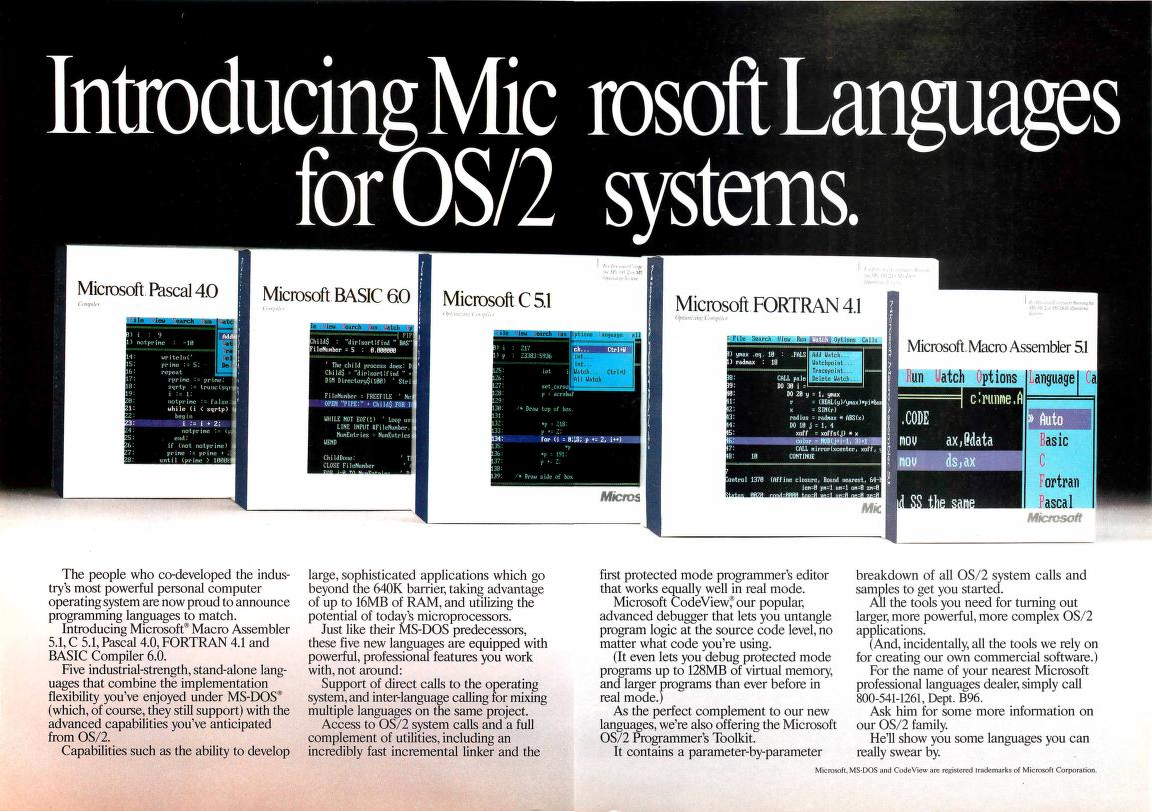
An advert for Microsoft Languages for OS/2 (Byte Magazine, June 1988)
OS/2 1.1
In October 1988 OS/ 1.1. arrived with the promised graphical user interface, Presentation Manager. As you can see it had strong ties to Microsoft Windows 2.x from a look and feel perspective.
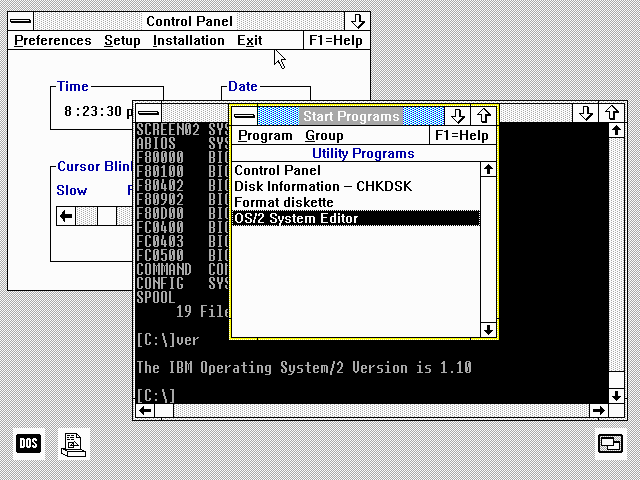
IBM OS/2 1.10 running Presentation Manager, its graphics user interface
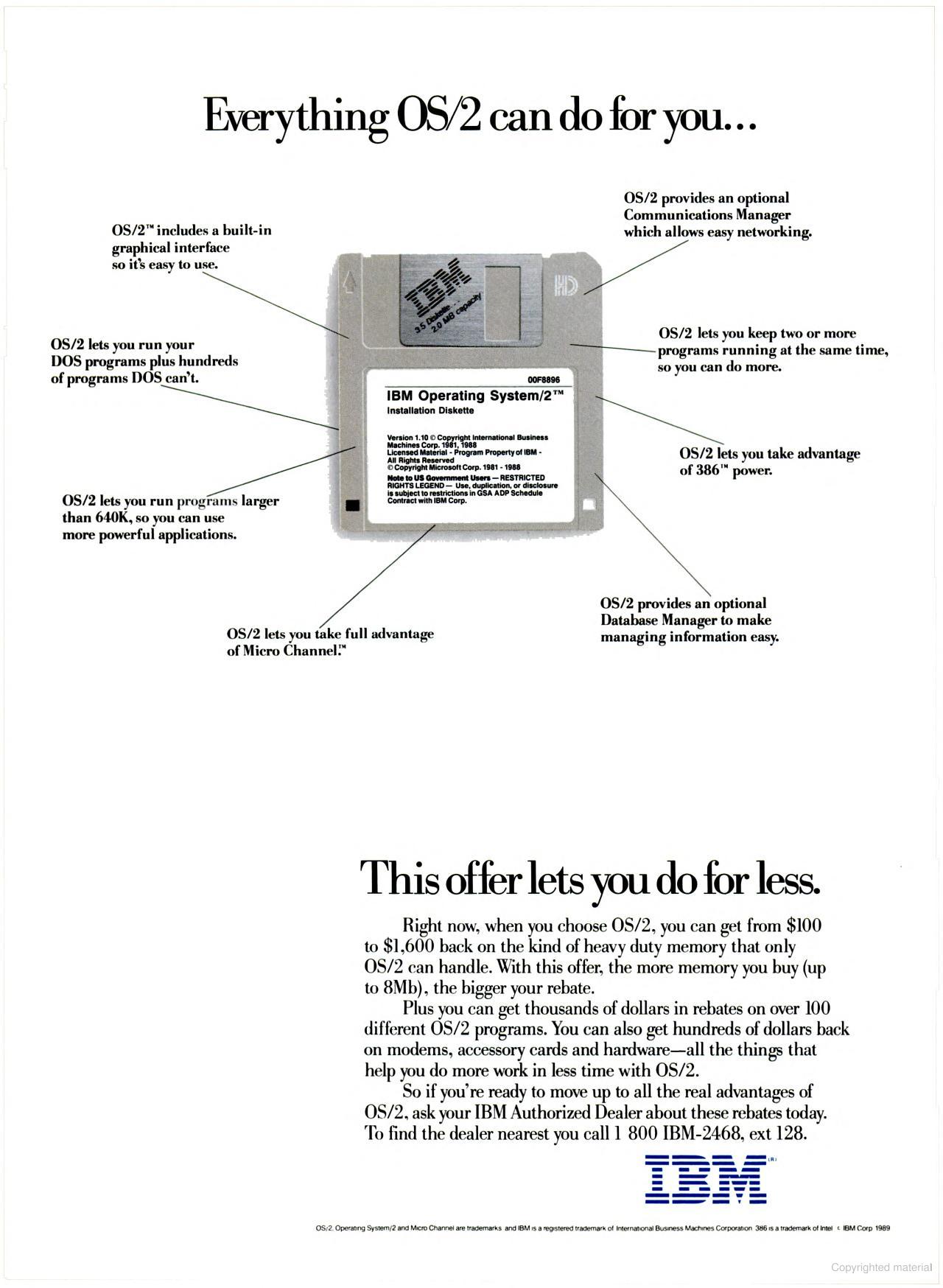
An advert for OS/2 version 1.10 (August 1989)
OS/2 1.2
OS/2 1.2 arrived in 1989, and introduced Installable File Systems, most crucially of them the High Performance File System (HPFS). HPFS overcame almost all the limitations of the earlier FAT file system including support for long filenames, support for extended attributes, larger partition sizes of up to 64 GB (compared to FAT16's 2 GB limit), a tighter structure to avoid wasted disk space with 512-byte sectors (FAT16 often used 64 KB cluster sizes), and far less need for defragmentation.
OS/2 1.2, like its forebear, was sold in two versions: Standard Edition and Extended Edition. Extended Edition added networking support for TCP/IP and Ethernet.
OS/2 1.3
OS/2 1.3 arrived in late 1990, aimed to be sold as a server platform for IBM LAN Manager. It didn't really add any major new features over 1.2 and can be considered more a stop-gap until OS/2 2.x was ready. They made the code more efficient, reduced memory requirements, and improved performance. Again, there was two versions: Standard Edition (SE) and Extended Edition (EE). The Extended Edition arrived in December 1990, one month after Standard Edition. Both versions added REXX scripting language support, Adobe Type Manager with a built-in set of fonts, and an improved printing subsystem.
The key relationship between Microsoft and IBM in collaborating on OS/2 was well and truly over by this time, with Microsoft working on Windows 3.0 and Windows NT (as well as other products like LAN Manager and SQL Server), and IBM continuing to work on OS/2 2.0. Windows NT was still in its infancy at the time of OS/2 1.3's release- it wouldn't arrive until mid-1993.
OS/2 1.3 was still limited to a single 640 KB DOS shell which did not support Expanded Memory Specification (EMS), while Windows NT could leverage EMS and XMS memory specifications.
OS/2 2.x
See my article from early July 2026, Let's Explore: OS/2 2.11, where I do a more detailed deep dive of the operating system, walk through a complete OS/2 2.11 installation, and check out its compatibility for OS/2 native apps, Windows apps, and DOS.
OS/2 2.0 was released in April 1992, and sold for $195 ($45 more than Microsoft Windows 3.0). It added a 32-bit API for running native OS/2 applications, but could also run 16-bit programs without issue. OS/2 2.0 was now able to leverage 386 memory management, ran almost all DOS programs, and ran most Windows applications as well. IBM now supported clone computers, and had largely abandoned its PS/2 Microchannel family for the same PCI, ISA, IDE, SVGA architecture everyone else had adopted. Version 2.0 introduced the Workplace Shell (WPS), which allowed the user to perform traditional computing tasks such as accessing files, printers, launching legacy programs, and advanced object oriented tasks using built-in and third-party application objects that extended the shell in an integrated fashion not available on any other mainstream operating system.
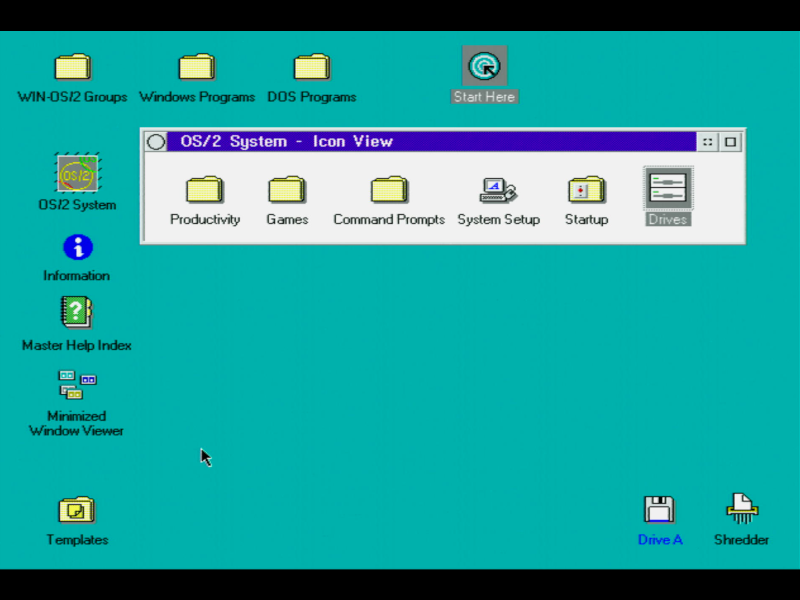
IBM OS/2 version 2.11
OS/2 Warp
The final full release of OS/2 was entitled OS/2 Warp, and was released in the Autumn of 1994. This could also be called OS/2 version 3.0. Crucially, Warp hit the market nine months before Windows 95, and was actually a much more functional operating system with real program integrity, priorities, and server-quality I/O. Very cleverly, Warp not only allowed a combination of 16-bit and 32-bit programs to run side-by-side, but elements within a single program could run in 16-bit or 32-bit mode. Unlike Microsoft's offerings both before and after Warp arrived, OS/2 Warp did not rely on at-the-time pretty archaic DOS underpinnings.
Warp provided much broader hardware support, greater multimedia capabilities, Internet-compatible networking, and it included a basic office application suite known as IBM Works. It was released in two versions: the less expensive "Red Spine" and the more expensive "Blue Spine" (named for the color of their boxes). "Red Spine" was designed to support Windows applications by utilizing an existing installation of Windows on the computer's hard drive. "Blue Spine" included Windows support in its own installation, and so could support Windows applications without an existing Windows installation.
So why did it fail? There are a number of reasons commonly attributed to the decline of OS/2 compared to Microsoft Windows. Firstly, and probably the most impactful, was Microsoft's actions. Microsoft pressured system vendors into long-term contracts to have Windows pre-loaded onto their PCs. Secondly, one of the key selling points of OS/2 was its excellent DOS and Windows compatibility. This meant software application developers could write their application for Windows and it would still work well under OS/2. Developing for OS/2 natively required more effort (partly due to Microsoft and IBM going their separate ways when it came to APIs), which was unnecessary and costly. Thirdly, IBM never quite learned to market anything well, especially outside the corporate world. Even when faced with stiff competition from Microsoft, IBM never put their full weight behind retail marketing of the product, and even failed to do what you'd think was obvious: sell all IBM PS/2 systems with OS/2 pre-installed. With parallels to the Betamax vs VHS war, the superior product lost.
The very last release IBM made of OS/2 Warp was version 4.52 in 2001. Specifically release 14.089_W4.