Orchid Pro Designer II / Pro Designer IIs
The Orchid Pro Designer II, launched in 1991, was a very fast graphics adapter compatible with the IBM VGA standard.
|
Released | 1991 |
| Bus | ISA 16-bit | |
| Chipset | Tseng Labs ET4000AX | |
| Standards | Hercules, MDA, CGA, EGA, VGA | |
| Memory | 512 KB or 1 MB DRAM | |
| Ports | 15-pin DSUB (analogue video out) | |
| Part # | 830-0045-X (long board) 830-0071-X (short board) |
|
| FCC ID | DDS7EF0190-90-PRO DDS7EF0191-91-PRO |
|
| Price | Apr 1991: $569 (PDII) Aug 1991: $304 (PDII), $184 (PDIIs) Sep 1991: $449 list (PDIIs, 1 MB) Oct 1991: $199 (PDIIs 512K) Feb 1992: $219 (PDIIs), $129 (PDII 512K) |
|
| See Also |

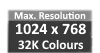

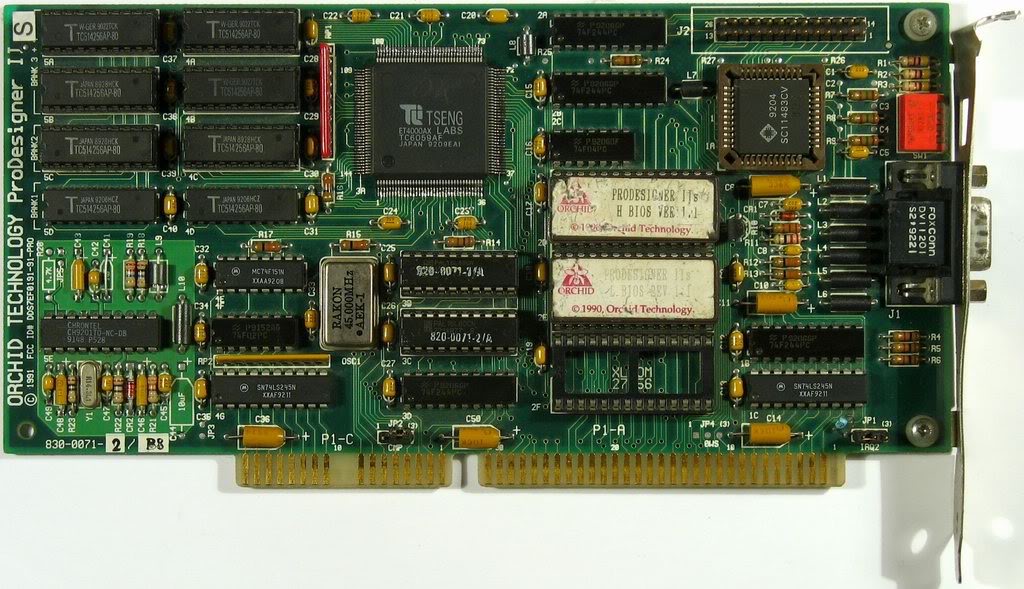
The Orchid Pro Designer IIs provided up to 32768 colours at 1024 x 768 with a 72 Hz refresh rate with the 1 MB video RAM version, and if the Sierra HiColor RAMDAC is installed, the maximum resolution at this colour depth is 1024 x 768.
These are one of those rare cards that will work in either an 8-bit or 16-bit ISA or EISA slot, with auto-detection to switch to 8 or 16-bit data transfer speeds.
Orchid also released the ProDesigner IIs for the EISA (called ProDesigner IIs/EISA) and MCA (called ProDesigner IIs/MC) buses.
Board Revisions
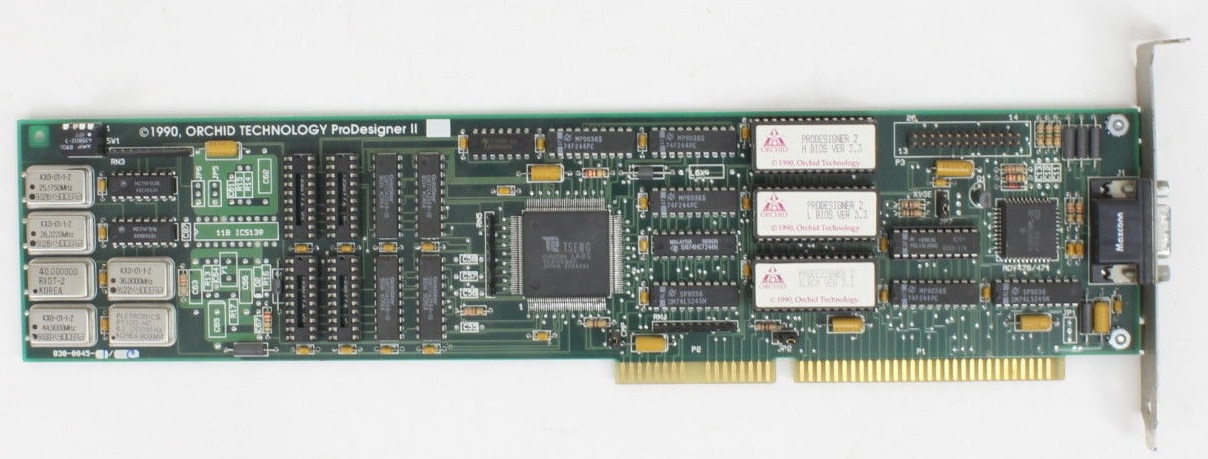
The Orchid Pro Designer II card came in a number of board revisions. The major board revision, i.e. 1 or 2, does not indicate whether it's a short board or long board (both '1' and '2' revisions were manufactured in both short and long form). It is more likely Orchid worked to cost-reduce the ProDesigner II in 1991 with the most obvious change to replace the up to six individual crystal oscillators with a single 45 MHz crystal and a couple of PAL chips which presumably work as clock dividers for the various video mode refresh rates.
All long boards had part number 830-0045-X.
All short boards has part number 830-0071-X.
ProDesigner II Rev. 1A: short board (1991)
ProDesigner II Rev. 1B: long board (1990)
ProDesigner II Rev. 1B4: short board (1991)
ProDesigner II Rev. 1C: long board (1990)
ProDesigner II Rev. 2B1: short board (1991)
ProDesigner II Rev. 2D1: long board (1990)
ProDesigner IIs Rev.
2P8: short board (1991)
I've also never seen a 'long board' ProDesigner IIs, so presumably the IIs variant came after the 1991 cost-reduction, and the 's' suffix probably stands for 'short'.
Competition
The ProDesigner II and IIs competed in a very crowded market in 1991, a time when the focus was really in pushing higher resolutions in Windows at decent refresh rates. In order to achieve this, the chipset and RAMDAC were critical components of any card you chose. Key graphics card competitors included ATI VGA Wonder XL, Diamond SpeedSTAR HiColor VGA, VideoSeven VRAM II, STB Powergraph Ergo-VGA, and Everex VRAM VGA. Kings of the hill were typically ATI's VGA Wonder XL and VideoSeven's VRAM II.
The Tseng Labs ET4000 chipset was hugely popular, with most cards sporting this chipset sitting near the top of the leaderboard in most tests, though ATI with their attention to detail on driver performance was supreme. VRAM was expensive, but some cards were starting to make use of it and reap the performance benefits. Other chipsets that were common included those from Chips & Technologies, VideoSeven/Headland Technology.
In the Media
CONS: Expensive
The most outstanding feature of the Orchid ProDesigner II is speed—it tied for first place in the key AutoCAD tests. Other than that, the board has an average set of features and a fairly high $304 street price.
Like most boards in this roundup, the ProDesigner II offers flicker-free 72 Hz performance at all resolutions except 1024 by 768. That may limit your options, but on today's 14-inch multiscans, most people won't experiment beyond 800 by 600 anyway.
The board isn't quite plug and play, but unless a network board is present, you probably won't have to mess with the board's handful of jumpers. Driver installation involves issuing commands from the DOS prompt instead of simply choosing menu options.
Thanks to its speedy performance, AutoCAD users may want to consider this board seriously. In addition, by the time you read this, Orchid will be shipping a new version of the ProDesigner II (the IIs) that will list for $120 less and purportedly will offer the same speed, 70-Hz refresh at 1024 by 768, and a special upgrade that will support over 32,000 colors under Windows. These new features should make the Pro-Designer IIs one of the hottest Super VGA boards around." PC World, August 1991
Utilizing the Tseng ET4000 chip set, the ProDesigner IIs offers all the same features of the ProDesigner II, as well as some improvements. Redressing the shortcomings of the earlier model, the ProDesigner IIs now supports a Super VGA and VGA vertical refresh rate of 72 Hz (the older board only managed 56 Hz) and has DIP switches located on the mounting bracket so you no longer have to open the PC to make an adjustment. Maximum resolution is 1,024 by 768 pixels with 256 simultaneous colors and a 70-Hz vertical refresh rate (non-interlaced).
Orchid supplies an impressive number of software drivers to cover most business, DTP, and CAD applications (including a display-list driver for AutoCAD). In addition to the regular array of VMODE utilities supplied with Tseng-based boards, Orchid includes extended text modes, video BIOS acceleration (disabled for PC Magazine Labs' tests), and a rudimentary custom font designer.
One ProDesigner II drawback that Orchid has not remedied with the ProDesigner IIs is the lack of VGA monitor support for older applications running in EGA, CGA, or Hercules video modes. If you want to run such applications and your VGA Monitor cannot handle the lower horizontal frequencies required by those modes, you will have to spend $25 for Orchid's optional translation ROM. This is a needless nuisance, since many less-expensive adapters give you this capability without making you spend extra money.
On PC Labs' Microsoft Windows performance tests, we tested the board with the standard Samsung RAMDAC and 1MB of RAM in zero-wait-state mode. In VGA modes the ProDesigner IIs performed below par under Windows. But in Super VGA modes the board delivered impressive performance. In both 16- and 256-color modes, it beat all 12 of the other Tseng-based boards in our roundup.
We separately tested the high-color Sierra and Edsun RAMDACs, with 1MB of DRAM installed. Among the tightly packed Sierra HiColor results, the Orchid was faster than most of the other Sierra-outfitted boards. However, at 32,768 colors in Super VGA mode, the Sierra RAMDAC's vertical refresh rate drops to an eye-straining 56 Hz. Orchid anticipates it will increase the vertical refresh rate of the Sierra-equipped version to 70 Hz by late summer.
Windows performance using the anti-aliasing Edsun RAMDAC generally looked very smooth, with the ragged edges in Paintbrush all but eliminated, for example. But there are still a few bugs in the Windows Edsun driver: mysterious dark bars moving at the edge of the image, occasional font smearing, and some moire patterns when executing contiguous line draws. (The Genoa SuperVGA 6400VG experienced the same difficulties).
The PC Labs Windows and VGA benchmark tests indicate that the Orchid ProDesigner IIs has a little growing to do before it blooms in VGA modes, but the socketed RAMDAC may be a good hedge against future performance and color upgrades. The preliminary documentation for the Edsun and Sierra upgrades is excellent, so users can pull chips like a technician (but if you require help from one, you will have to make a toll call). But even with the ProDesigner IIs' four-year parts-and-labor warranty, you can find a better performance value elsewhere." PC Magazine, September 1991
Setting it Up
The Orchid Pro Designer IIs has four DIP switches accessible on the backplate. The first two are used to set the monitor's vertical refresh rate:
| Configuration | 640 x 480 | 800x 600 | 1024 x 768 | |
| SW1/SW2 | Off/Off (default) | 60 Hz | 60 Hz | 60 Hz |
| SW1/SW2 | On/Off | 60 Hz | 56 Hz | 45 Hz (i) |
| SW1/SW2 | Off/On | 72 Hz | 72 Hz | 60 Hz |
| SW1/SW2 | On/On | 72 Hz | 72 Hz | 70 Hz |
SW3 and SW4 are factory-set and there is no mention of them in the manual, though some other Orchid cards have them setup for the following:
| Configuration | Meaning | |
| SW3 (Shadow ROM) | ON | When video shadow ROM is enabled and the system won't boot. |
| OFF (default) | When there is no conflict. |
| SW4 (Speed Boost) | ON | Boosts the speed of text and graphics operations from 10% - 25% by setting the card to run with zero wait states on bus accesses. |
| OFF (default) | Standard speed. |
The Orchid Pro Designer IIs has these jumpers:
| Configuration | Meaning | |
| JP1 | 1-2 | IRQ9 enabled. Enables the use of IRQ2/9 to control the use of the Vertical Interrupt. |
| 2-3 (default) | IRQ9 disabled. | |
| JP2 | 1-2 | Motherboard compatibility on - Enables the Fahrenheit 1280 to operate when installed in motherboards which use non-standard bus timing signals. Set this to 1-2 if the system does not boot. |
| 2-3 (default) | Set to this if the sign-on message is scrambled at boot up or graphics modes are scrambled in the software you are using. |
Downloads
Operation Manual Original user manual for the Orchid Pro Designer II |
Original Utility Disk 5.25" floppy disk with drivers for the ProDesigner II series |
Original Utility Disk For the ProDesigner IIs |
VGA ROM BIOS Get in touch if you can provide this missing item! |
VGA ROM BIOS Get in touch if you can provide this missing item! |
VGA ROM BIOS Get in touch if you can provide this missing item! |
VGA ROM BIOS Get in touch if you can provide this missing item! |



More Pictures

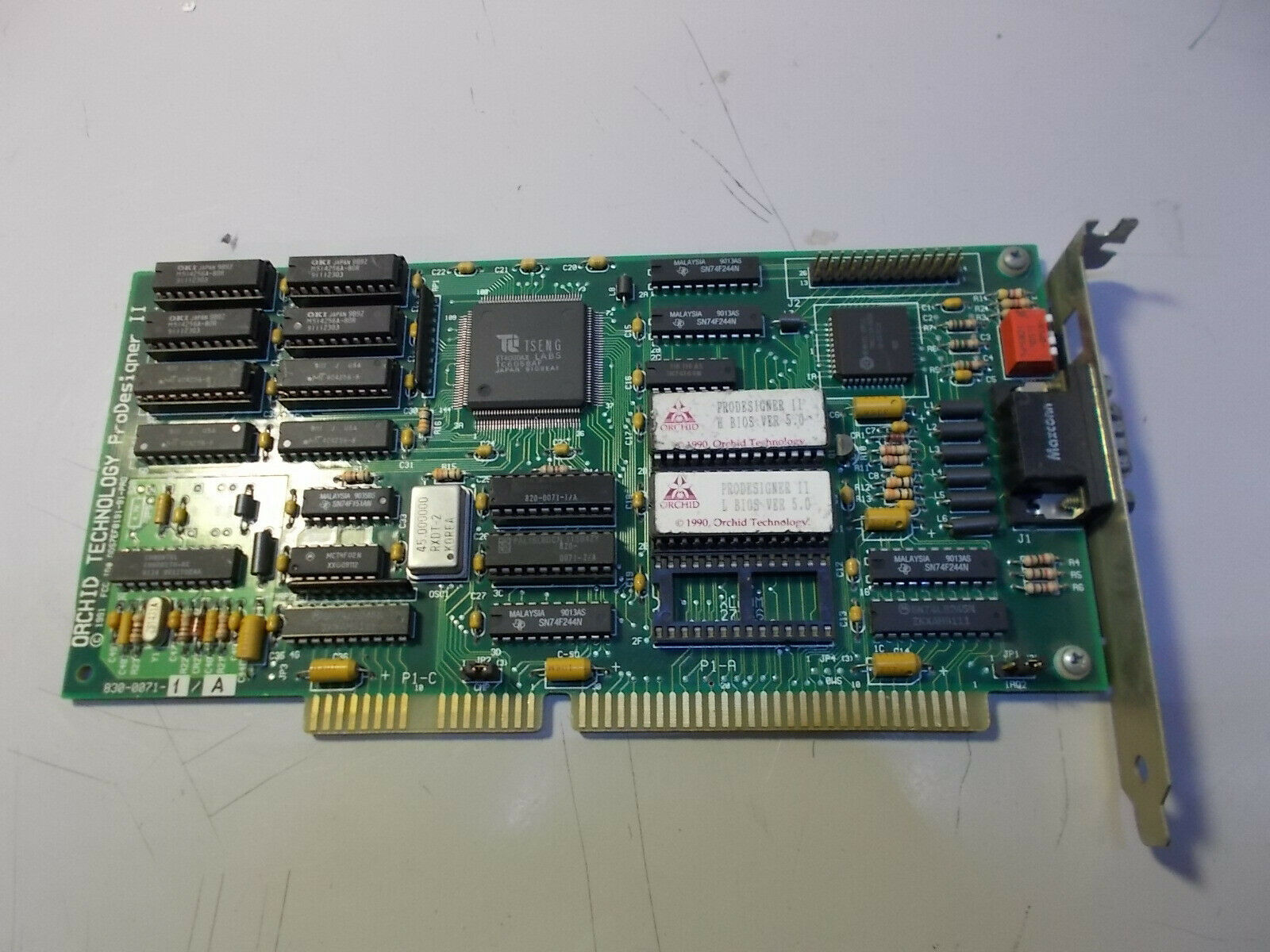
Orchid ProDesigner II Rev.1A